RWA Handover (HOTO) Audit
RWA Handover Audit — Make the Builder Fix It Before You Sign
60+ societies have taken possession with every defect on record.
WHAT WE DO
We ensure smooth handover from the builder to RWA
HOTO stands for Handover Takeover — the process by which a builder officially transfers a residential apartment complex to the Residents’ Welfare Association. We not only help RWAs of projects which are completed in all respects and are due for taking over by the association, but also projects in progress where we conduct inspection for sections which are currently ready and inspect the rest after total completion.
In today’s urban landscape, ensuring the safety and quality of residential buildings is of utmost importance. Workmanship quality audits play a crucial role in maintaining transparency and accountability between builders, resident welfare associations (RWAs), and homeowners during the Builder to Society Handover process. Below you will find the various aspects of building audits, the responsibilities of builders, and the benefits for homeowners and associations.
AUDIT SCOPE
Nemmadi’s Building Audit Services
For residential properties undergoing Builder to Society Handover Takeover — every aspect assessed for quality, safety and compliance.
Civil Quality Audit
Inspection and snagging of common areas (civil & building services).
MEP Quality Audit
Reporting on condition and quality of common areas.
MEP Design Audit
Assesses the design of mechanical, electrical and plumbing systems to ensure they meet required standards and are adequate for the building’s requirements at full occupancy.
Documentation Audit
The checklist of documents an RWA must collect from a builder, divided into four groups — Property, Operations, Finance and Legal.
AMC Audit
Guidance on the desirable statutory documents to be handed over to the association.
De-Snagging
Re-inspection of the snag list to confirm the builder has actually closed out what the audit found.
THE PROCESS
From Builder to Association
Builder Builds
The builder completes the apartment complex and applies for the occupancy certificate.
RWA Inspection
Nemmadi audits the common areas and building services before the association signs anything.
Handover Documents
The builder hands over the property, operations, finance and legal documentation.
Resident’s Welfare Association
The RWA takes over a complex whose defects are documented and on the builder’s side of the line.
SCOPE
What Does an RWA Handover Audit Cover?
 View full size ↗
Building quality audits are thorough evaluations of residential properties, covering aspects such as legal compliance, civil engineering workmanship checks, dampness, and sewage treatment plant (STP) and water treatment plant (WTP) assessments. Third-party auditors, like us, conduct these assessments, ensuring an unbiased evaluation of the property during the Builder to Association Handover.
MEP Design Audit assesses the design of mechanical, electrical and plumbing systems, to confirm they meet required standards and are adequate for the building at full occupancy — not just on handover day.
- Legal compliance & regulatory standards
- Civil engineering workmanship & construction quality
- Dampness — moisture detection & waterproofing
- Sewage treatment plant (STP) efficiency
- Water treatment plant (WTP) & filtration
LEGAL POSITION
The Role of Builders and Legal Responsibilities
Under Section 14(3) of the RERA Act, a builder must put right structural defects — and defects in workmanship, quality or the provision of services — at no further charge and within thirty days, where an owner brings them to the builder’s notice within five years. If the builder does not, the affected owners are entitled to compensation.
That five years runs from the date possession of the flat was handed over — not from the date your association takes over the common areas. The Karnataka Real Estate Appellate Tribunal decided this exact point in November 2025, holding that handing the project to the association is “only an administrative event” which does not alter when the period starts: Arshi Ahmed v. L&T Construction Equipment Ltd, Appeal No. (K-REAT) 17/2024, 26 November 2025, at paragraph 35.
In practice the window is shorter than most committees assume, and it is already running. That is why the condition of the building is worth documenting at handover, in writing and with photographs. If the builder will not act on the findings, owners and the association can seek legal recourse.
- Defects notified to the builder inside the five-year window are the builder’s to rectify
- At no further charge — and within thirty days of being notified
- A third-party report is the factual basis any claim rests on
General information, not legal advice — we are quality auditors. Sources are linked so your committee and its advocate can read them first-hand: Section 14(3), Real Estate (Regulation and Development) Act, 2016 (Karnataka RERA’s copy, PDF), and the tribunal order above. A single state appellate tribunal has decided this point; no High Court or Supreme Court ruling exists, and authorities elsewhere have used other start dates.
RERA CHAPTER III, SECTION 17
“How long after practical completion is the handover?”
 View full size ↗
According to the Real Estate Regulation and Development Act (RERA), Chapter III, section 17, clauses 1 and 2, the builder must transfer ownership of the completed apartments and common areas to the resident welfare association (RWA) or the competent authority within a specified period as per local laws. This transfer of title can also be referred to as handover.
Specifically, the conveyance deed must be executed and physical possession given to the allottees, and the common areas to the RWA, within three months from the date of the occupancy certificate. Additionally, the builder must hand over necessary documents and plans, including those for common areas, within thirty days after obtaining the completion certificate.
KARNATAKA APARTMENT BILL, 2026
What the Law Will Require at Handover
Karnataka has published a Bill that would spell out, for the first time, exactly what a builder must hand to your association — and by when.
Status, as at 28 August 2026: this is a Bill, not an Act. Both Houses have now passed it — the Legislative Assembly on 21 August 2026 and the Legislative Council on 24 August 2026 (LA Bill No. 14 of 2026, gazetted 19 August 2026). It is still not law: it needs the Governor’s assent and a commencement notification from the State Government under clause 1(2), and neither has happened. Nothing in this section binds any builder today.
We are publishing it anyway, because it is the clearest statement anyone has of what a complete handover should look like — in the government’s own words, with clause numbers you can check for yourself.
Documents, within 60 days of the Occupancy Certificate
Fifteen categories of records, listed above. The association would have to acknowledge receipt in writing and send a copy of that acknowledgement to the competent authority — so the handover leaves a paper trail on both sides.
Clause 16(1)(b)
The money, within the same 60 days
Every rupee collected from buyers towards maintenance deposits, security deposits, corpus fund and advance maintenance — plus the interest accrued on it — transferred to the association, together with an audited statement of accounts showing the position project-wise and buyer-wise.
Clause 16(1)(c)
The association, within 3 months of majority allotment
The promoter would have to facilitate forming and registering the association within three months of a majority of the apartments being allotted, and then hand over possession and control of the common areas, all records and plans, all funds, and the running of every service installation.
Clause 21(2) and 21(11)
The fifteen documents, in full
Today there is no single list, which is precisely why so much goes missing. Clause 16(1)(b) would set one, and give the builder sixty days from the Occupancy Certificate to produce all of it:
- Title documents for the land
- The declaration filed with the competent authority
- The lease deed or lease certificate, where the land is held on lease
- Sanctioned plans, approvals and completion certificates
- As-built drawings and structural drawings
- Statutory compliance certificates — fire safety, lift safety and environmental approvals
- Insurance policies relating to the project
- Encumbrance certificates and related records
- Electrical wiring diagrams, plumbing layouts and service drawings
- Purchase, installation and commissioning records for all equipment and machinery
- Operation manuals, service manuals and warranty documents for every installation
- Maintenance contracts and AMCs, with vendor contacts, for lifts, generators, fire safety systems, water treatment plants and other common facilities
- User manuals, access credentials and software documentation for building management and electronic security systems
- Receipts for municipal taxes, fees and statutory dues paid up to the handover date
- Any further records the rules made under the Act may prescribe
If the builder doesn’t comply
This is the part that would change most. The Bill creates a Competent Authority with the powers of a civil court, two levels of appeal above it, and a defined route for complaints. Under clause 52(1), a builder who does any of the following could be fined up to ₹1 lakh, plus up to ₹1,000 for every further day the failure continues:
- Failing to file the declaration
- Failing to facilitate formation of the association
- Failing to execute the deed of transfer
- Handing over possession of a flat without an occupancy certificate
A complaint could be made by your association’s secretary, by anyone the committee authorises, or by any single aggrieved owner — the authority can also act on its own. And clauses 10(8) and 21(13) — the Bill says it twice — confirm that handing management to the association does not end the builder’s obligations under RERA, including rectifying structural defects during the liability period described further up this page.
What this changes for your audit
Nothing, in principle — and that is rather the point. The list above is what a complete handover looks like, and it is very close to the documentation audit we already run. What the Bill would add is a deadline, a penalty and somebody to complain to. What it cannot do is tell you whether the lift really works, whether the STP was ever commissioned, or whether the as-built drawings match the building you are standing in. That gap — between the paperwork a builder produces and the complex you actually inherit — is what an audit is for.
General information, not legal advice. For a definitive reading of the Bill or your society’s position, consult a qualified advocate. Full text: Karnataka Gazette, Part IVA, No. 745, 19 August 2026. Our plain-English walkthrough: the Karnataka Apartment (Ownership & Management) Bill, 2026 explained.
Home Inspections vs. Association Audits
While home inspections focus on individual apartments, association audits cover common areas and shared facilities. A typical home inspection for a 2,000 sq. ft. apartment takes about 4–4.5 hours, while the duration of an association audit depends on the property’s size and complexity.
STEP BY STEP
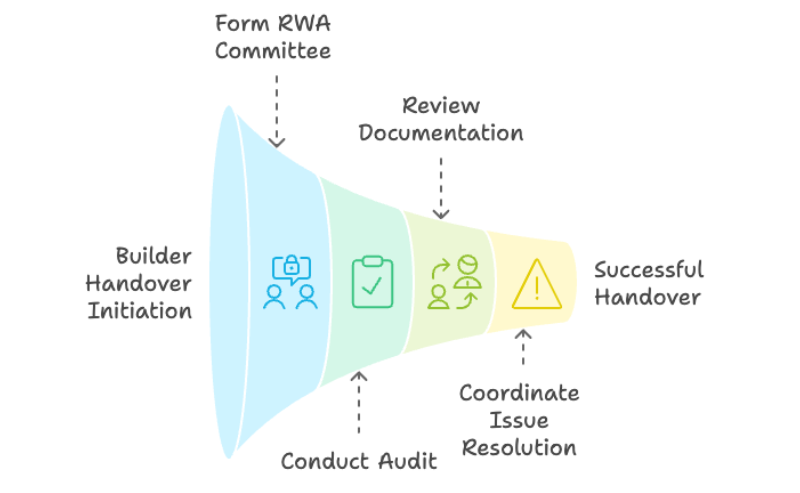
How to Take Handover from a Builder
Taking handover from a builder involves a series of steps to ensure a smooth transition and guarantee the property’s desired condition.
Form a Committee
Form a strong RWA or ad hoc committee to represent homeowners’ interests and address issues with the builder effectively.
Commission an Audit
Conduct building quality audits using a third-party auditor like Nemmadi.
Verify Documents
Review and verify essential documentation provided by the builder.
Close the Snags
Coordinate with the builder to rectify any identified issues and ensure compliance with audit report findings.
DOCUMENTATION
What Documents are Given by the Builder at the Time of Possession?
During the handover takeover process, the builder should provide several essential documents, including building permits and approvals, occupancy certificates, structural and architectural drawings, warranty documents, maintenance contracts and records, property tax receipts and utility bills, and any other relevant legal or regulatory documents.
Once the RWA is formed and the handover process begins it is essential that the RWA receives all the documentation from the builder for the building. This is probably the most important aspect — once the builder has completed the handover to the RWA, any future compliances of the building will fall under the aegis of the RWA. Some obvious and critical documents are:
Occupancy Certificate
Completion and occupancy certificates are proof that the building is completed as per the approved plan and government compliances. If the builder is unable to provide you with these certificates, then either the building laws have been violated or there are deviations from the original construction plans. Either way, it’s illegal to occupy a building/apartment that does not have an occupancy certificate.
NOC Certificate
A No Objection Certificate (NOC) is issued where there is no objection to the covenants of the certificate. A builder has to compulsorily submit an NOC from the fire safety, water, and pollution departments to the RWA (Residents Welfare Association).
COVERAGE
Audited Areas during Builder to Society Handover
Nemmadi’s comprehensive quality audits cover various areas in residential properties, including but not limited to:
MORE INFORMATION
Call or WhatsApp us about your complex
Talk to an engineer about your society’s handover — scope, timeline and what the audit would cover.
See a sample RWA report → Download booklet → Send us your details →
TRACK RECORD
Some of the RWA audits we have done
60+ apartment societies helped to take possession from their builders.
 Prestige Falcon City
 Prestige Song of South
 Purva Palmbeach
 Prestige Woodside
 Assetz Lumos
 Brigade Buena Vista
 Prestige Garden Bay
 Mahindra Windchimes
 DivyaSree 77 Place
 Peninsula Heights
 Club Meadows
 Lake Verandah
 Purva Midtown
 Tree by Provident
 Radiant Lakeview
Empowering Transparency, Ensuring Quality
Why it is important to conduct workmanship quality audits to ensure quality and safety.
The Importance of Concerted Effort by Homeowners
By forming a strong RWA or ad hoc committee and speaking in a single voice to the builder, backed by factual findings, will result in a win-win situation for all. Builders would be glad to oblige and would not stake their reputation if it is conveyed in the right manner quoting the relevant standards by professionals. Many times the findings will be a new learning for all.
In conclusion, comprehensive quality audits are essential for ensuring quality and safety in residential buildings during the Builder to Society Handover process. With Nemmadi’s range of audit services, homeowners and resident welfare associations can gain valuable insights into their properties’ condition and take the necessary actions to maintain a safe and comfortable living environment. By addressing all relevant aspects of the handover process, from builder responsibilities to the documents required, these audits contribute to a more transparent and accountable relationship between builders, RWAs, and homeowners.
GET STARTED
Protect Your Community’s Investment
A professional RWA handover audit so your society inherits quality, not defects. Pricing is scoped per complex — tell us your unit count and amenities.
Frequently Asked Questions
When should we do the handover audit — before or after we take over from the builder?
Before. Signing the takeover does not release the builder from its RERA obligations — but it does shift the practical burden onto you. Once you have accepted the assets without a record of their condition, it is your committee that has to prove a defect was already there, and in the meantime residents fund the repairs out of their own maintenance corpus. An audit done before you sign puts those findings on record while you still have leverage.
We have already taken handover. Is it too late to audit?
No — but the clock matters more than most committees expect. Under Section 14(3) of the RERA Act the builder must rectify structural defects, and defects in workmanship, quality or the provision of services, where an owner brings them to the builder’s notice within five years. That five years runs from the date possession of the flat was handed over, not from the date your association took over the common areas — the Karnataka Real Estate Appellate Tribunal confirmed exactly that in Arshi Ahmed v. L&T Construction Equipment Ltd, Appeal No. (K-REAT) 17/2024, 26 November 2025. So part of your window may already have gone. An audit now still gives you documented, engineer-backed findings to take back to the builder, and the sooner it is done, the more of the window is left.
How long after the occupancy certificate must the builder hand over to the RWA?
RERA Chapter III, Section 17 sets it out: the conveyance deed must be executed and physical possession of the common areas given to the association within three months of the occupancy certificate, and all documents and plans — including those for common areas — handed over within thirty days of obtaining the completion certificate.
Karnataka's Apartment (Ownership and Management) Bill, 2026 would add a second, tighter deadline: sixty days from the occupancy certificate for fifteen categories of documents, and for the transfer of every maintenance deposit, security deposit and corpus fund — with interest, and with an audited statement showing the position buyer by buyer. That Bill is not yet law; it was gazetted on 19 August 2026, passed by the Legislative Assembly on 21 August 2026 and by the Legislative Council on 24 August 2026, and comes into force only when the State Government notifies a date. See what the Bill would require at handover.
How long is the builder responsible for defects after handover?
Five years, under Section 14(3) of the RERA Act, counted from the date possession of the flat was handed over. It is not automatic: the window covers defects an owner actually brings to the builder’s notice inside it. Do that, and the builder must rectify them at no further charge, within thirty days.
Taking over the common areas does not restart those five years. The Karnataka Real Estate Appellate Tribunal held that handing the project to the association is “only an administrative event” which does not alter when the period begins — Arshi Ahmed v. L&T Construction Equipment Ltd, Appeal No. (K-REAT) 17/2024, 26 November 2025, at paragraph 35. Documenting the building’s condition early, in writing and with photographs, is what protects you. This is general information, not legal advice.
What if the builder refuses to act on the audit findings?
That becomes a conversation between your management committee and its legal representative — we are quality auditors, not legal advisors. What we can tell you is that RERA authorities have sided with homebuyers in a great many builder-defect disputes, and a professional third-party audit report gives your committee the factual basis such a case rests on.
This may get easier. Karnataka's Apartment (Ownership and Management) Bill, 2026 would create a Competent Authority with the powers of a civil court, two levels of appeal above it, and penalties of up to ₹1 lakh plus ₹1,000 a day against a builder who fails to hand over, fails to help form the association, or hands over flats without an occupancy certificate — on a complaint from your secretary, anyone the committee authorises, or any single owner. The Bill is not yet in force. We have written it up in plain English: the Karnataka Apartment (Ownership & Management) Bill, 2026 explained. Either way, the report is what any of these routes rests on.
What is the difference between an RWA Handover Audit and an RWA Health Check?
The Handover Audit is one-time due diligence at the point of transfer from builder to association. The RWA Health Check is for associations that took over some time ago and want an independent read on the current condition of their assets.
Does our association need to be legally registered before we can commission an audit?
No. An ad-hoc committee is perfectly acceptable. What matters far more than registration status is that homeowners speak to the builder in a single voice, backed by factual findings.
Do we need the builder’s permission for the audit?
In practice this has not been an obstacle for us. Access is normally arranged between your committee and the builder as part of the handover process itself; where a builder is reluctant, that is a matter for your committee and its legal representative to take up.
Our complex was handed over in phases and is only partly occupied. Can you still audit?
Yes. We audit the sections that are complete and ready now, and inspect the remainder once construction finishes. We work with both fully completed projects due for takeover and projects still in progress.
How is an RWA handover audit priced?
Between ₹3,000 and ₹6,000 per unit, depending on the size of the society and the range of amenities to be covered — clubhouse, STP, WTP, DG sets, lifts, firefighting systems and so on. Pricing is calculated on a minimum of 100 units. Request an RWA audit quote and we will scope it for your complex.


