Everything you need to know about the Builder to Society Handover process in Bangalore and Karnataka apartments.
If you’ve searched for “HOTO” or “HOTO full form” and ended up here, you’re likely a resident of an apartment complex in Bangalore or Karnataka trying to understand the Builder to Society Handover process when your builder hands over control to your Resident Welfare Association (RWA). You’re not alone—thousands search for this information every month, yet most content fails to clearly explain what HOTO actually means and why it matters.
What is HOTO? (Full Form & Meaning)
HOTO stands for: Handover-Takeover
It’s the formal process where a builder/developer transfers ownership, control, and management responsibilities of an apartment complex to the Resident Welfare Association (RWA) or Apartment Owners Association (AOA).
Think of it as:
- Handover: Builder hands over the project documentation, assets, systems, and control
- Takeover: RWA takes over management, maintenance, and operational responsibilities
Why HOTO Matters to You as an Apartment Owner
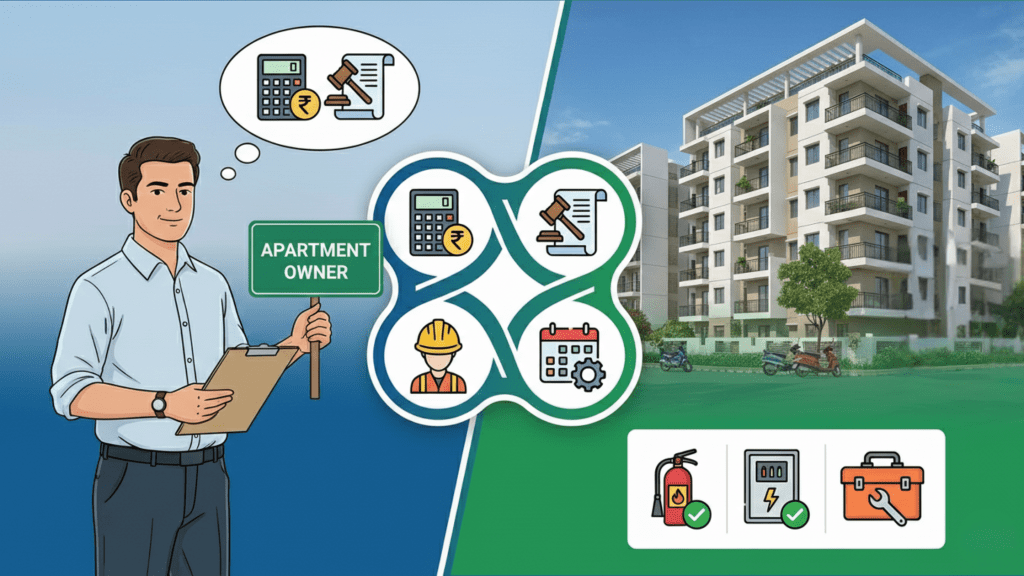
The HOTO process is arguably the most critical transition in your apartment complex’s lifecycle. Here’s why:
- Financial Impact: Poor HOTO can result in ₹50 lakhs to ₹2 crores in unexpected repair costs for a 200-unit apartment complex
- Legal Protection: Proper documentation received during HOTO is essential for claiming warranty and pursuing legal recourse against builders
- Safety & Compliance: Fire safety systems, electrical installations, and sewage treatment plants must be verified as compliant during HOTO
- Long-term Maintenance: Understanding the actual condition of building systems helps RWAs plan accurate maintenance budgets
When Does HOTO Happen?
HOTO typically occurs when:
- 60-80% of flats are sold and occupied
- Builder has completed common area infrastructure
- RWA/AOA has been formally registered
- Builder is ready (or pressured) to exit day-to-day management
Reality check: Many builders delay the Builder to Society Handover or rush it without proper documentation. This is why a structured HOTO audit is crucial.
The Technical Audit: Your Most Important Investment
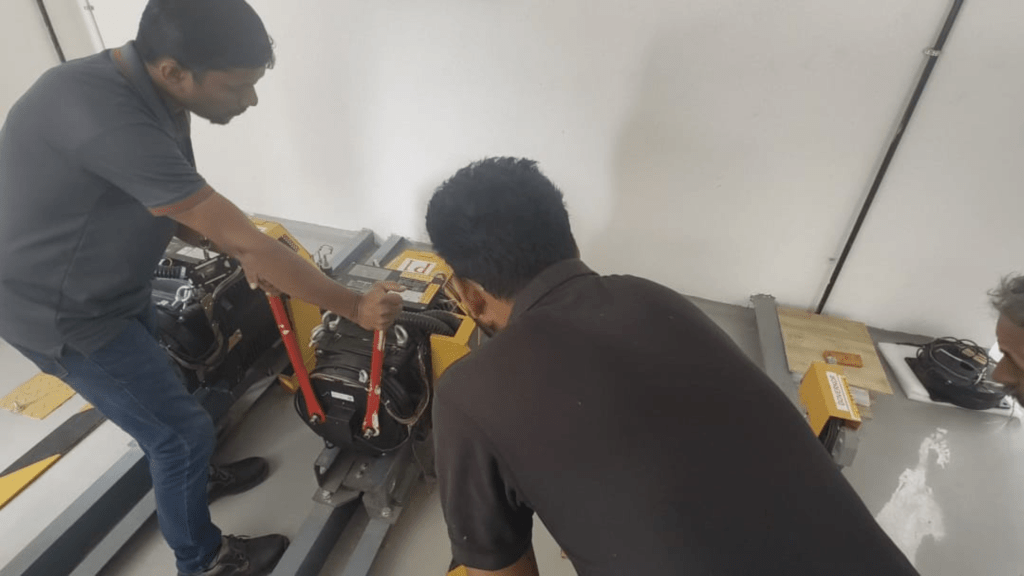
Why Professional Technical Audits Are Non-Negotiable
Facility management companies are trained for operations, not defect identification. They often have conflicts of interest—minimizing findings to secure lucrative maintenance contracts.
What You Need: An independent technical audit firm with:
- Multi-disciplinary engineering expertise (civil, structural, electrical, mechanical, plumbing)
- Advanced diagnostic equipment (thermal imagers, moisture metres, electrical testers, load banks)
- RWA HOTO experience and RERA compliance understanding
- No stake in future facility management contracts
The 7-System Comprehensive Audit
- Building Envelope: External walls, waterproofing, expansion joints, cracks (categorised by type), balconies. Tools: moisture metres, thermal imaging.
- Electrical Safety: Panels, earthing (life-critical), DG capacity, transformer adequacy, solar systems. Tools: earth testers, load bank testing, thermal imaging.
- Water Supply: Pumps, tanks, WTP/RO, borewell, pressure adequacy. Tools: pressure gauges, TDS metres.
- Fire Protection: Detection systems, sprinklers, hydrants, emergency exits, firefighting pumps. Tools: smoke tests, pressure testing per NBC 2016.
- Sewage & KSPCB: STP functionality/capacity, KSPCB consent, effluent quality (BOD, COD, TSS), stormwater. Tools: lab testing, capacity assessment. Critical: Operating without KSPCB consent = RWA legal liability.
- Lifts: Mechanical systems, safety features, ARD functionality, load testing, certification. Tools: load testing equipment.
- Documentation: Legal documents completeness, authenticity verification, as-built drawings, financial records, vendor contracts.
Understanding HOTO: A Technical and Critical Legal Process
HOTO (Handover-Takeover) is the Builder to Society Handover process where your builder transfers ownership, control, and management of your apartment complex to the Resident Welfare Association (RWA). This involves legal title transfer, statutory compliance, financial settlement, technical accountability, and governance establishment.
The Technical Process: What Actually Happens
The HOTO process involves multiple critical components:
- Physical Infrastructure Transfer
- Common areas (lobbies, corridors, staircases, parking, terraces)
- Amenities (clubhouse, gym, swimming pool, landscaping)
- Building systems (lifts, generators, water supply, STP, fire safety)
- Equipment and machinery with warranties and operation manuals
- Documentation Handover
- As-built drawings (architectural, structural, MEP)
- Equipment specifications and maintenance manuals
- Vendor contracts and service agreements
- Insurance policies for building and equipment
- Financial Settlement
- Corpus fund transfer with audited statements
- Maintenance advance collected from residents
- Utility deposits (water, electricity)
- Bank account transfers and balance verification
- Utility Connections Transfer
- Electricity connection from BESCOM (metre transfer to RWA)
- Water connection from BWSSB (billing account transfer)
- STP operations (KSPCB compliance transfer)
- Property tax account updates
- Operational Transition
- Security, housekeeping, and maintenance staff handover
- Vendor contract continuity or renegotiation
- Emergency contact procedures and protocols
This entire technical process must be verified through independent professional audits before acceptance.
The Legal Foundation: RERA and KAOA

RERA Section 17: Builder’s Mandatory Obligations
Under the Real Estate (Regulation and Development) Act 2016, Section 17 explicitly mandates:
“Every promoter shall register the transfer of common areas, appurtenances or facilities, to the association of the allottees, as per the registered conveyance deed on or before the date of submission of the completion certificate.”
Key Requirements:
- Enable formation of allottees’ association
- Execute and register conveyance deed transferring common areas
- Transfer all amenities, parking, green spaces, and facilities
- Provide all statutory clearances and completion documentation
- Ensure zero financial liabilities on the association at handover
RERA Section 14(3): Your 5-Year Protection
Defect Liability Period: Builders remain liable for:
- Structural defects: 5 years from date of possession
- Other defects: 2 years from possession
- Builder’s obligation: Rectify defects within 30 days of notification at no cost
This protection only works if you properly document defects during HOTO.
Karnataka Apartment Ownership Act (KAOA) 1972
KAOA governs apartment ownership in Karnataka with two critical requirements:
- Deed of Declaration (DOD) – Form A
The DOD is your master document defining:
- Property layout and structure
- Individual unit specifications
- Common area definitions (lobbies, staircases, parking, amenities)
- Ownership percentages (typically per square footage)
- Cost-sharing ratios for maintenance
Critical Timeline: The DOD must be registered before or concurrent with the conveyance deed. Many builders delay this, creating ownership ambiguity.
Registration Requirements:
- Prepared in Form A format
- Requires builder signature and initial owner signatures (typically 100%)
- Registered at Sub-Registrar’s office
- Requires stamp duty payment (typically 2% of property value in Karnataka)
Common Problem: Some builders register under the wrong legislation (Karnataka Society Registration Act 1960 instead of KAOA). This creates problems when collecting maintenance fees and requires costly transition later.
- Association Formation Options
You have three legal structure options in Karnataka:
| Structure | Pros | Cons | Best For | |
| KAOA 1972 Association | Aligned with apartment law; simpler governance | Limited juristic person status; restricted tax benefits | Smaller complexes; straightforward ownership | |
| Cooperative Housing Society | Full legal standing; tax benefits; democratic governance; can own property | More regulatory compliance; larger administration overhead | Larger complexes; anticipated lending needs | |
| Section 8 Company | Strong legal status; professional governance; institutional lending access | Complex registration and compliance; requires professional management | Large premium projects; institutional investors |
Recommendation: Most associations should register as Cooperative Housing Societies, which provide legal standing while aligning with apartment ownership principles. KAOA 1972 alone has a significant juristic person gap.
The Pre-HOTO Phase: Building Your Foundation
Step 1: Form Your RWA Early (Don’t Wait for the Builder)
Timeline: Start when 30-40% occupancy is reached
Critical Actions:
- Convene meeting of apartment owners (minimum quorum per act)
- Draft and adopt bylaws aligned with KAOA/Cooperative Act
- Elect interim Managing Committee (President, Secretary, Treasurer minimum)
- File registration application with appropriate authority
- Open bank accounts in RWA’s name
- Establish communication channels (WhatsApp groups, email lists)
Pro Tip: A registered RWA has negotiating power. Builders facing organised associations are less likely to cut corners.
Step 2: Understand the Conveyance Deed (Your Legal Shield)
The conveyance deed transfers ownership of common areas from builder to association. Essential contents include:
- Parties and Property Description: Builder/promoter to association; detailed common areas with measurements
- Area Schedule: Itemized list matching DOD
- Builder Warranties: Clear title, no encumbrances, all approvals obtained
- Liability Exclusions: Builder is responsible for all outstanding utility arrears, property tax, and contractor claims
- Maintenance Fund: Corpus amount transferred
- Date of Transfer: Critical for DLP calculation (5-year period starts here)
Registration: Stamp duty 2% of property value in Karnataka; must be registered at Sub-Registrar’s office.
Financial Settlement: Following the Money
The Opening Balance Sheet
Your opening balance sheet establishes the financial starting point and protects against future disputes.
Assets (What RWA Receives):
- Corpus fund transferred (verify with bank statements)
- Sinking fund (if separate for major repairs)
- Security deposits held from residents
- Maintenance advance collected (typically 3-6 months)
- Value of common area assets (equipment, furniture at notional value)
- Outstanding maintenance receivables (from defaulters)
Liabilities (What RWA Owes):
- Outstanding utility arrears (must be cleared by builder)
- Pending vendor bills
- Security deposit refund obligations to residents
- Known repair obligations (DLP rectification budget)
- Staff salary/gratuity obligations carried over
Requirements:
- Audited by independent Chartered Accountant
- Signed by builder’s authorized representative
- Approved by RWA Managing Committee
- Presented to General Body within 30 days
Corpus Fund Verification
What is Corpus Fund? Reserve fund for major capital expenditures, not routine maintenance. Typically collected at ₹200-500 per sq ft.
Calculation Example:
- 200 units × 1,000 sq ft average × ₹300/sq ft corpus = ₹6 crores expected
- Verify actual balance equals collections minus legitimate capital expenses only
Common Builder Tactics to Watch:
- “Administrative fees” deducted (usually unauthorized)
- Corpus “loaned” to another builder project
- Revenue expenses incorrectly charged to corpus
- Creative accounting showing lower balance
Verification Process:
- Cross-check corpus collected with individual resident payment records
- Review all corpus expenditures with supporting invoices
- Verify bank statements showing corpus account balance
- Check FD receipts if corpus was invested
- Calculate per-resident corpus balance
- Demand reconciliation for any shortfall
Utility Arrears: Critical Pre-Handover Requirement
Builder must clear all arrears before conveyance deed execution.
Required No-Dues Certificates:
- Electricity: from BESCOM/ESCOM
- Water: from BWSSB/municipal water board
- Sewerage: from sewerage authority
- Property Tax: tax clearance from municipal authority
If Arrears Exist: Refuse handover acceptance until cleared. Include indemnity clause in handover agreement for any hidden arrears discovered later.
The Holdback Strategy
What is Holdback? Portion of corpus retained by RWA until critical defects are resolved.
How to Calculate:
- Identify all Critical and Major defects
- Get rectification quotes from 2-3 contractors
- Calculate total cost
- Add 20% buffer for contingencies
- Holdback amount = Total cost + buffer
- Typical: 10-15% of corpus fund
Release Conditions (include in handover agreement):
- All Critical defects rectified and verified by audit firm
- All Major defects rectified or covered by bank guarantee
- Written sign-off by RWA Managing Committee
- Payment within 30 days after verification
Why It Works: Money is leverage. Without holdback, you have no negotiating power post-handover.
Service Contracts and Vendor Transition
Review all existing contracts and compare rates with market benchmarks:
Critical Contracts: Lift maintenance, generator/DG set servicing, security services, STP operations, housekeeping & waste management
For Each Contract: Obtain original document, verify last payment, compare rates (get 3-4 quotes), decide to continue or retender, ensure smooth transition without service interruption.
Post-Handover: First 90 Days
The First General Body Meeting (Within 30 Days)
Critical Agenda: (1) Formal acceptance vote, (2) Approve opening balance sheet and budget, (3) Set maintenance fees, (4) Review/amend bylaws, (5) Ratify vendor contracts, (6) Elect permanent Managing Committee, (7) Approve defect tracking process.
Setting Realistic Maintenance Fees
Calculate annual costs including staff salaries, equipment AMCs, utilities, insurance, legal fees, repairs, and 10-15% contingency. Present 3-year projection with itemized breakdown. Example: ₹1.1 crore annual costs for 200-unit complex = ₹5,400/month per unit (assuming 85% collection).
When to Escalate to RERA
File RERA complaint when: (1) Builder refuses OC/documents, (2) Builder won’t fix defects despite evidence, (3) No response within 30 days, (4) Indefinite handover delays, (5) Financial discrepancies.
Process: Prepare evidence (defect photos, notifications, technical audit, builder response), file online at rera.karnataka.gov.in, attend hearing (within 60 days), receive binding RERA order. Non-compliance penalties up to 5% of project cost.
Final Word: Protect Your Investment
The ₹1-3 lakhs you spend on professional technical audits, financial audits, and legal advice will save you ₹50 lakhs to ₹2 crores in post-HOTO surprises. This is a proven 10-30x ROI.
Your apartment is likely your biggest investment. The decisions you make during HOTO will impact your community for the next 30-50 years. Don’t rush. Don’t accept builder pressure. Get professional help.
About Nemmadi – Your HOTO Audit Partner
Nemmadi is a specialised building audit consultancy with 10 years of experience in Builder to Society Handover audits and RWA HOTO audits across Bangalore and Hyderabad. With a team of 31 engineers (civil, structural, electrical, mechanical, plumbing), we provide comprehensive 7-system building assessments that protect apartment communities from costly post-handover surprises.
Our HOTO Audit Covers:
- Building Envelope & Waterproofing
- Electrical Safety & Distribution Systems
- Water Supply & Treatment
- Life Safety & Fire Protection
- Sewage Treatment & KSPCB Compliance
- Vertical Transportation (Lifts)
- Documentation & Handover Readiness
Why Choose Nemmadi:
- Independent, conflict-free (no facility management contracts)
- Multi-disciplinary in-house engineering teams
- Advanced diagnostic equipment (thermal imagers, moisture metres, load testers)
- Root cause analysis, not just surface defects
- RERA-compliant documentation
- Average savings: ₹50 lakhs – 2 crores per complex