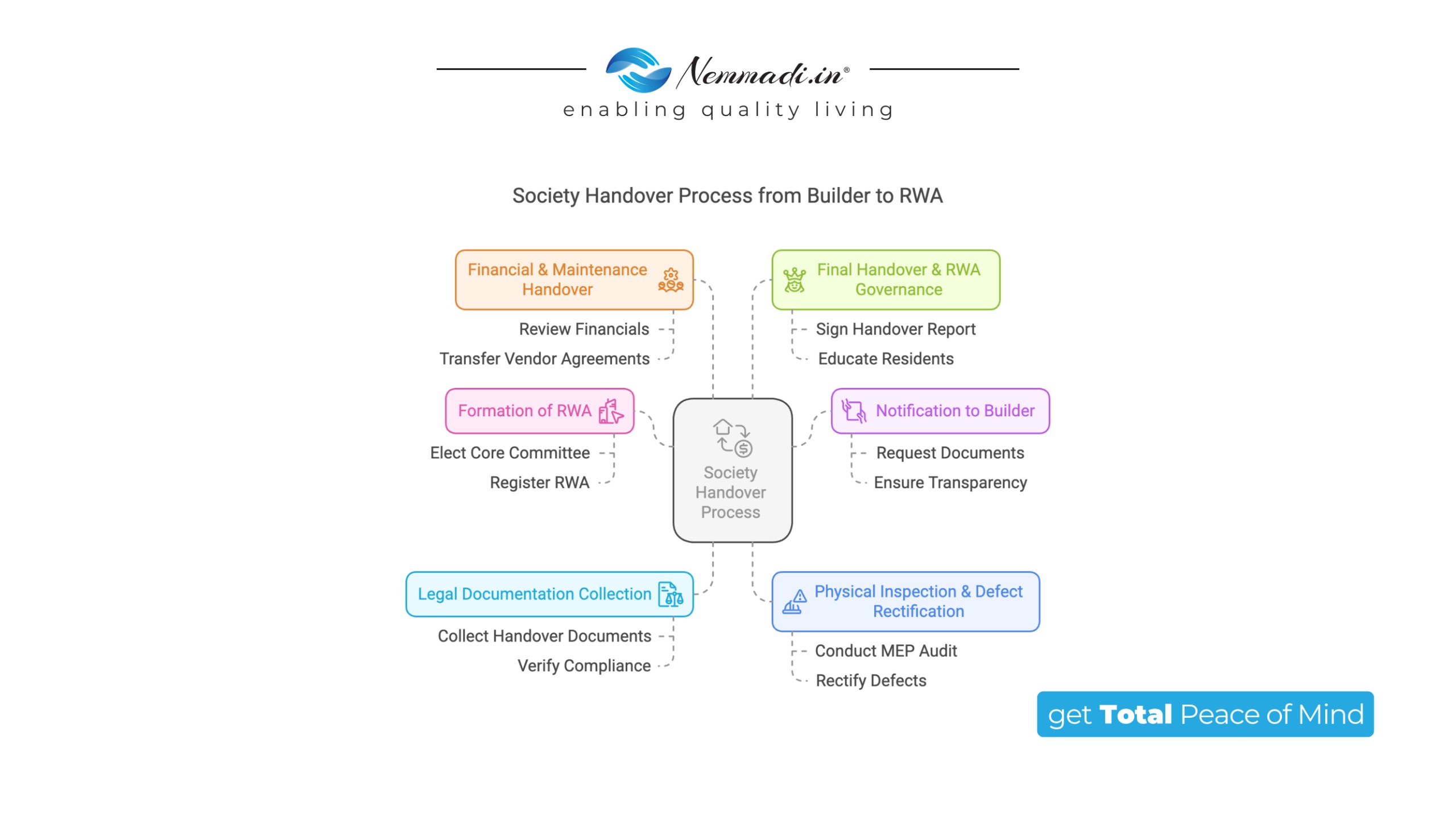
The transition of an apartment complex or gated community from a builder to a Residents’ Welfare Association (RWA) is a crucial step in ensuring transparency, accountability, and long-term sustainability. A structured handover process, backed by the right legal documents and checklists, can help homeowners take control of their society efficiently.
This guide provides a step-by-step process, legal requirements, challenges, and a downloadable Society Handover Checklist PDF to assist RWAs in navigating the transition.
Step-by-Step Timeline for Society Handover
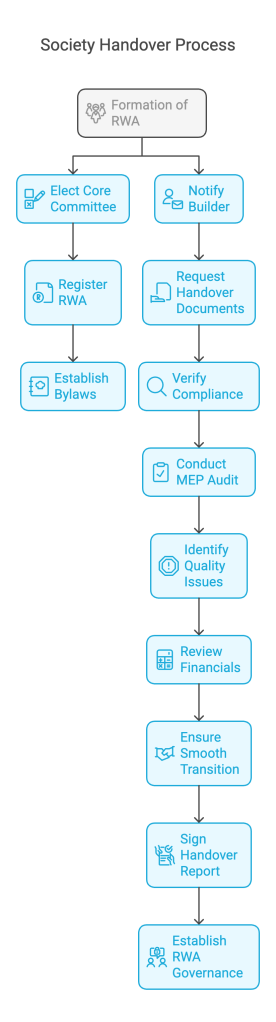
Step 1: Formation of the Resident Welfare Association (RWA)
- Gather interested homeowners and elect a core committee aka the Management Committee or the Executive Committee.
- Register the RWA under the Appropriate Act that is applicable in your state and other applicable state laws.
- Establish governing bylaws and define roles/responsibilities.
- Ensure your Deed of Declaration (DoD) is in place and registered
Step 2: Notification to the Builder
- Send a formal notice to the builder requesting a structured handover.
- Highlight the need for all necessary documents, pending approvals, and financial transparency.
Step 3: Legal Documentation Collection
- Request the handover documents from the builder (list provided in handbook).
- Ensure you verify compliance with RERA regulations and local authority norms.
Step 4: Physical Inspection & Defect Rectification
- Conduct a detailed MEP (Mechanical, Electrical, Plumbing) audit.
- Identify any workmanship quality issues or pending civil works.
- Share the audit findings document to escalate quality concerns.
Step 5: Financial & Maintenance Handover
- Review the society’s sinking fund and past expenses.
- Audit pending dues, security deposits, and AMC contracts.
- Ensure a smooth transition of vendor agreements and service providers.
Step 6: Final Handover and RWA Governance
- Sign off on the handover completion report.
- Establish RWA-led management of maintenance and security services.
- Educate residents on governance, compliance, and dispute resolution mechanisms.
Legal Documents Required for Society Handover
A well-documented handover ensures clarity and prevents future disputes. Here’s a comprehensive list of documents to collect from the builder:
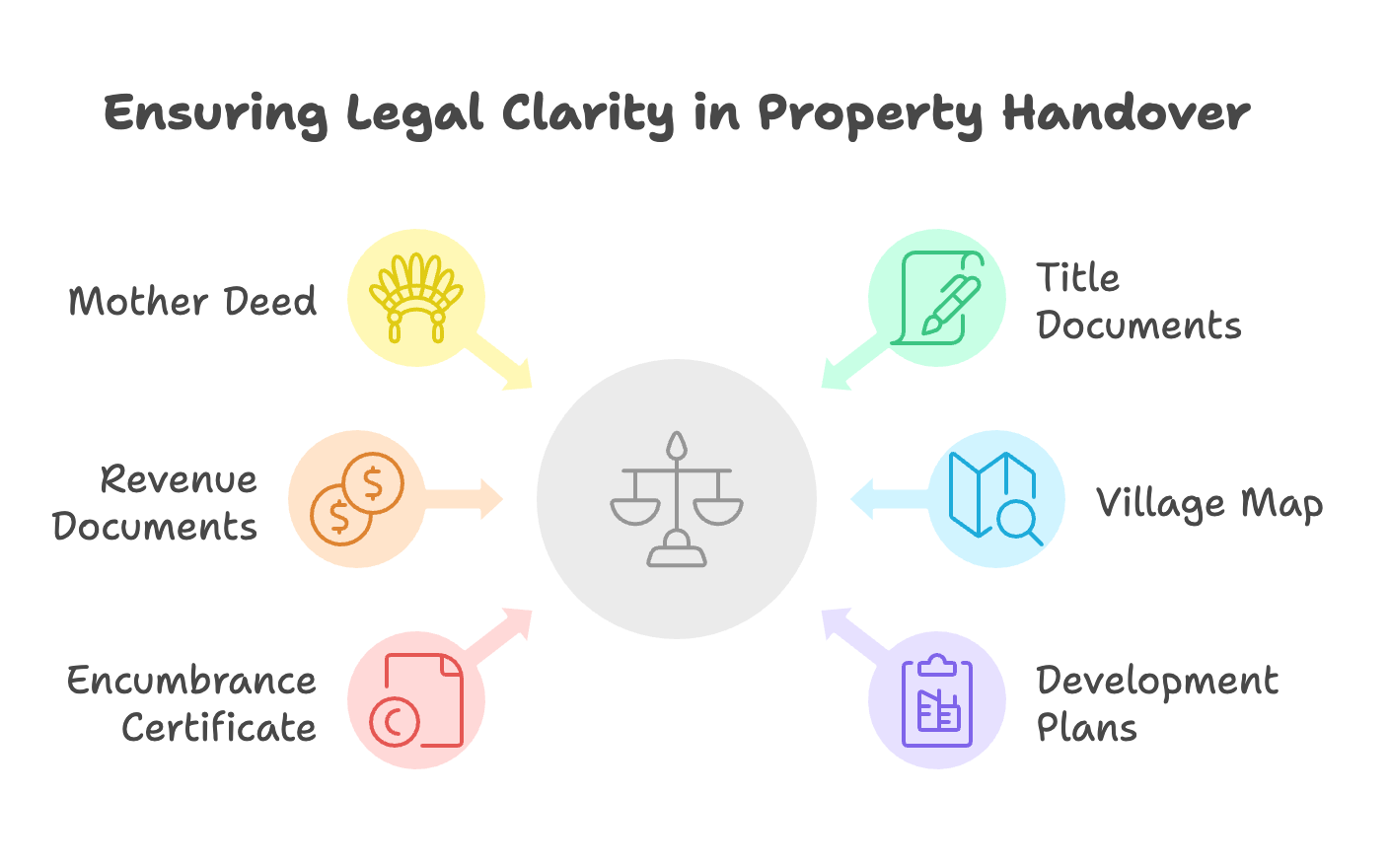
Several documents are needed for due diligence when purchasing property, including land and building documents. These documents help to ensure a clear title and that the property is legally sound.
The key documents to check include:
- Mother deed: This is the oldest available document related to the land. It establishes the land’s history and is important for tracing ownership. A minimum of 30 years of history is recommended, but 50 years is ideal.
- Title documents: These include sale deeds, gift deeds, and relinquishment deeds, which show how the property has been transferred between owners.
- Revenue documents: These verify that the title transfers have been recorded by the revenue authorities. Revenue documents include:
- RTC (Record of Tenancy and Crops): This document shows who the owner is and the extent of the land. It also reveals if there were any tenants who claimed ownership.
- Mutation Register Extract (MR): This document records transfers of land with revenue authorities.
- Akar band: This document shows the extent of the land and is checked to ensure it is consistent with the RTC.
- Village map: This map is checked for any encumbrances, such as lakes or pathways. The presence of a lake on the map, even if not physically present, can be a red flag.
- Encumbrance certificate: This document shows if the land was mortgaged or if any charges were created against it. It also verifies if a mortgage has been redeemed.
- Comprehensive Development Plan (CDP) and Revised Master Plan: These documents are relevant for urban areas and show the zoning of the land.
- Conversion order: This document shows the conversion of agricultural land for other purposes.
- Joint Development Agreement (JDA): This is an agreement between the landowner and the developer, giving the developer rights to develop the property.
- Supplemental Agreement or Sharing Agreement: This agreement specifies which apartments belong to the landowner and which belong to the developer.
- Power of Attorney (GPA): This gives the developer the authority to apply for permissions and sanctions.
- Sanction plan: This is the approved plan for construction, showing the layout of the entire property. The sanction plan is essential, and construction is considered illegal without one.
- No Objection Certificates (NOCs): These are required from various authorities, such as the metro, water and power authorities.
- Statutory requirements: This includes fire NOC, BWSSB, KPTC, and STP consent for establishment.
- Relinquishment deed: This document shows the surrender of land for public use. It typically includes internal roads, open spaces, parks, and civic amenities.
- Occupancy Certificate (OC): This document is essential, though the original is usually only provided at the time of handover. Due diligence should verify that it has been issued by the appropriate authority.
- Tax paid receipts: These receipts should be checked to ensure taxes are paid up to date.
- Khata: The Khata should be in the name of the last purchaser.
It is essential to check that the title and revenue documents are synchronised. A lawyer will also verify that all permissions are in place. It is best to obtain these documents before signing a sale deed, as builders may not provide original documents until the handover.
📥 Download Society Handover Checklist PDF
Common Challenges & How to Address Them
1. Incomplete Common Areas & Amenities
- Conduct an inspection and document pending work.
- Withhold maintenance transfer until obligations are met.
2. Missing or Delayed Documentation
- Escalate non-compliance to the local RERA authority.
- Consult legal experts if key documents are missing.
3. Pending Maintenance Funds & Discrepancies
- Audit builder-collected maintenance charges.
- Verify funds transferred to the RWA account.
4. Non-Functional MEP Systems
- Conduct a technical audit for HVAC, electrical panels, plumbing, etc.
- Seek professional assistance to rectify deficiencies before acceptance.
How to Form an RWA After Builder Handover
After a builder handover, forming a Resident Welfare Association (RWA) involves several key steps, primarily focused on understanding and adhering to the relevant laws and procedures in Karnataka. Here’s a breakdown of how to form an RWA, drawing from the sources:
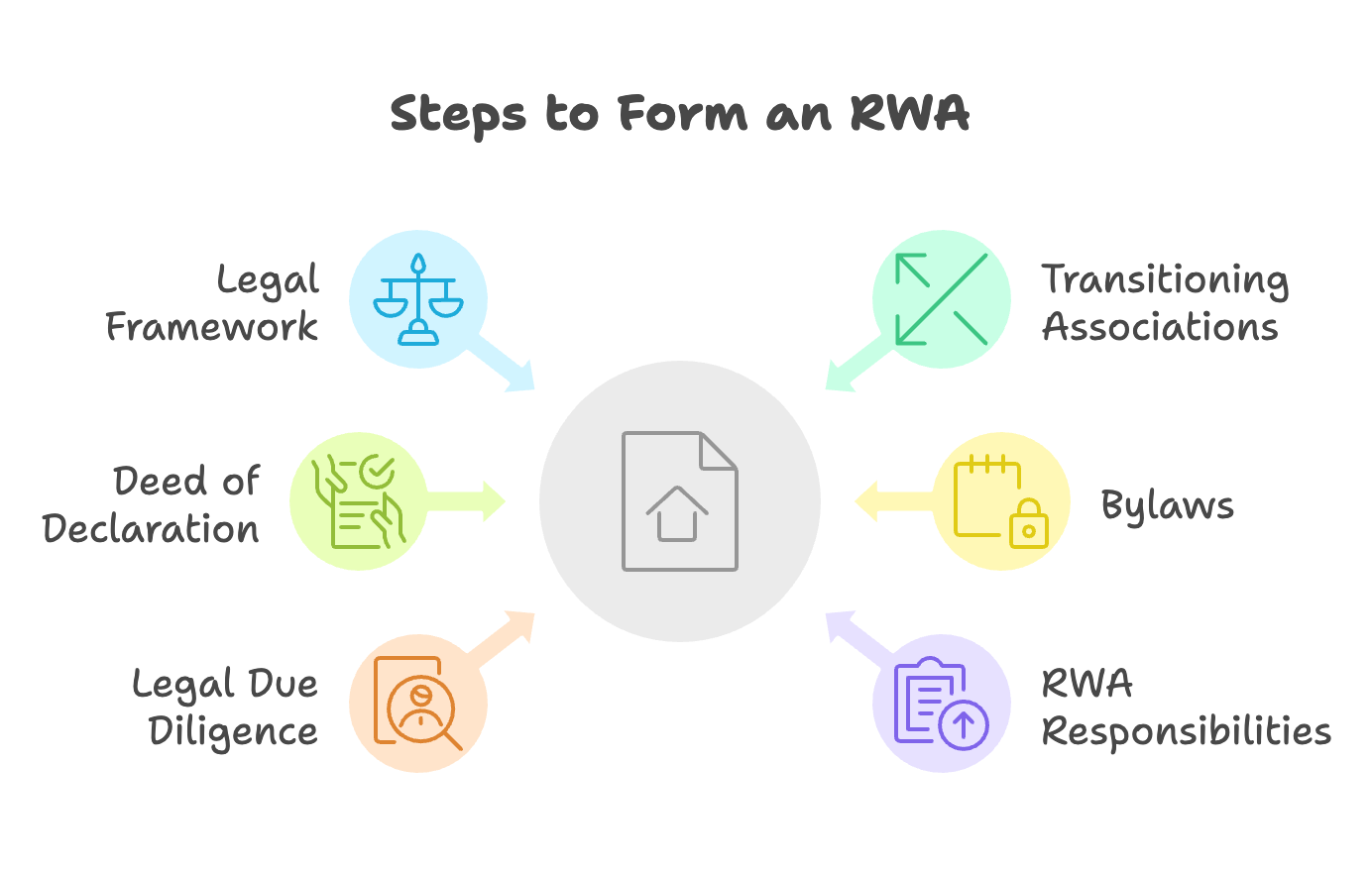
- Understanding the Legal Framework
- Incorrect Registration: Avoid registering the RWA under the Karnataka Society Registration Act of 1960, as this act is not meant for apartment associations and does not allow for the collection of maintenance.
- Correct Acts: The RWA should be registered under either the Karnataka Cooperative Societies Act of 1959 or the Karnataka Apartment Ownership Act of 1972.
- The Cooperative Societies Act allows for maintenance collection, although it can be a time-consuming process.
- The Apartment Ownership Act has some ambiguities and does not recognize the association as a juristic person.
- Other Options: RWAs can also be registered as a Section 8 company (a non-profit organization) or under the Partnership Act, though these options are not as common due to complexities.
- Transitioning from Existing Associations
- If the builder has already registered an association under the wrong act (like the 1960 Act), the RWA will need to transition to a different act.
- If there are multiple associations registered under different acts, it’s essential to unify under the correct act.
- Legal Ramifications: If the RWA is registered under the wrong act, residents may refuse to pay maintenance, as there is no legal basis for collecting it.
- Dealing with the Deed of Declaration (DOD) under the KOA
- Under the Karnataka Apartment Ownership Act, the Deed of Declaration (DOD) is a document that submits the property to be governed by the act.
- 100% Signatures: The DOD requires 100% of apartment owners to sign, which is difficult to obtain in large complexes.
- Builder’s Role: Builders often register the DOD before selling apartments, with the builder and land owner signing it as the initial owners.
- Subsequent Owners: Once the DOD is registered, new owners do not have the option to withdraw from it.
- Formulating and Amending Bylaws
- Bylaws at DOD Registration: Bylaws are usually formulated and registered at the same time as the DOD.
- Builder’s Bylaws: The bylaws are often provided by the builder, and these may have conflicting rules.
- Review and Amendment: After handover, the RWA needs to review these bylaws, identify any issues, and amend them.
- Majority for Amendments: Amending bylaws usually requires a two-thirds majority of all owners, which can be difficult to achieve. If this majority is not possible, the RWA may have to approach the courts.
- Importance of Bylaws: Bylaws are critical because they define the roles and responsibilities of the RWA office bearers and how the association is run.
- Legal Due Diligence
- Importance of Due Diligence: It is important to perform due diligence on the property which includes checking land records, permissions and other documents. This process helps to protect your investment and ensure the community is good.
- Land Scrutiny: Due diligence is not just about the apartment unit, it’s about the entire land on which the apartment is built.
- Key Documents: The due diligence process involves scrutinizing various documents, including the mother deed, title documents, revenue documents, village map, encumbrance certificate, sanction plan, and occupancy certificate.
- Independent Verification: It is important to do your own due diligence, and not solely rely on the builder’s or the bank’s due diligence, since the builder is incentivized to sell and the bank’s focus is the loan.
- Responsibilities of the RWA Management Committee
- Fiduciary Duty: The management committee has a responsibility to maintain the property and ensure it benefits all residents.
- Legal Liability: Office bearers can be held liable for issues with common areas but may also have indemnity coverage.
- Financial Responsibilities: The treasurer is responsible for handling the finances of the RWA, which should be in line with the bylaws.
- Maintenance Collection
- Legal Basis for Collection: The RWA needs to be registered under the correct act to legally collect maintenance from the residents.
- Legal Recourse: If residents do not pay, the RWA can issue notices, impose penalties (as per the bylaws) and ultimately pursue legal action.
- Relinquishment Deeds
- Surrendering Rights: When an apartment complex is constructed, some land rights have to be surrendered to the government. This includes areas for internal roads, parks, open spaces, and civic amenities, which then belong to the government.
- Public Use: While the association can use these spaces for their internal use, the government may decide to open them up for public access.
By following these steps and ensuring a thorough understanding of the legal requirements, a Resident Welfare Association can be formed effectively after the builder handover, protecting the interests of the residents and ensuring smooth community management.
Conclusion
A structured society handover ensures transparency, accountability, and better governance for residents. By following this guide and using the Society Handover Checklist, RWAs can streamline the transition, protect their rights, and establish a well-managed residential community.
📥 Download the full Society Handover Checklist PDF and ensure a smooth transition!