When a builder hands over a large residential apartment complex to the Resident Welfare Association (RWA), plumbing is often not the first item on the inspection checklist. However, plumbing defects in apartments are far more common than many RWAs expect. Pipes, valves, drains, and drainage systems run across every floor, basement, terrace, and landscaped area. If these systems fail, the financial burden ultimately falls on the residents.
This is where Nemmadi adds value. Through our RWA HOTO audits, we conduct detailed MEP quality checks and provide RWAs with clear, structured reports on plumbing and other critical MEP systems. Our inspections cover key areas such as basement parking, driveways, PHE shafts, open terraces, and landscape zones, where multiple snags are often identified and systematically categorized as high and medium

Here are the most striking findings
The Plumbing Defects That Stood Out
Open Terrace — Plumbing Downpipe Discharging Over Exposed Electrical Cables
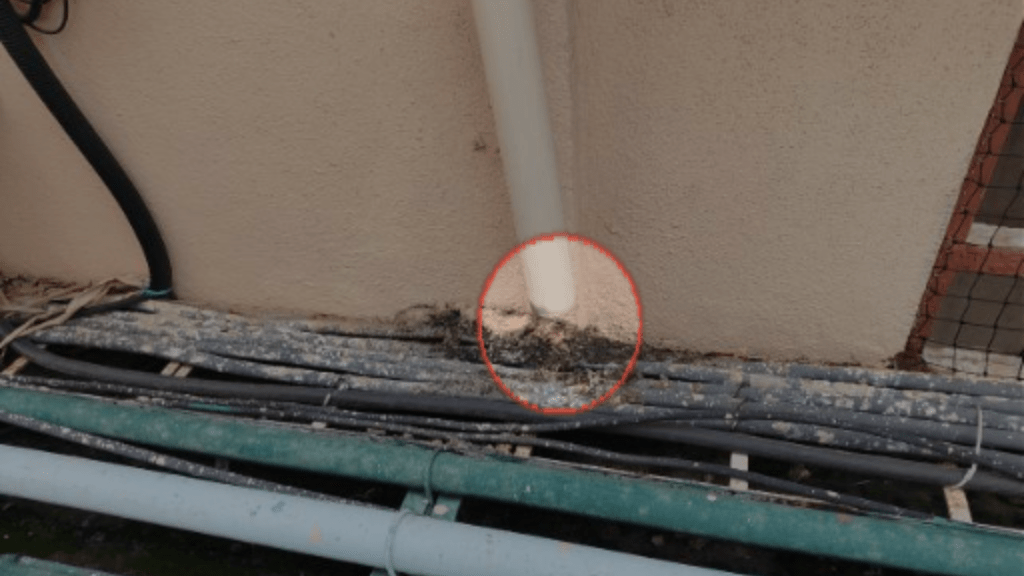
This is one of the most alarming plumbing defects in new apartments that auditors encounter. On the open terrace, a plumbing downpipe was found discharging water directly over exposed electrical cables. The risk is clear — water ingress, cable insulation damage, and potential short circuits or electrical faults.
This is not a plumbing problem in isolation. It is a safety hazard sitting at the intersection of two systems — plumbing and electrical — installed without any coordination between them. Water and live electrical cables on a rooftop is a combination that cannot be left unaddressed. And yet, it is the kind of defect that goes completely unnoticed in a standard builder walkthrough.
Open Terrace — Improper Drainage/Stagnation of Water Observed
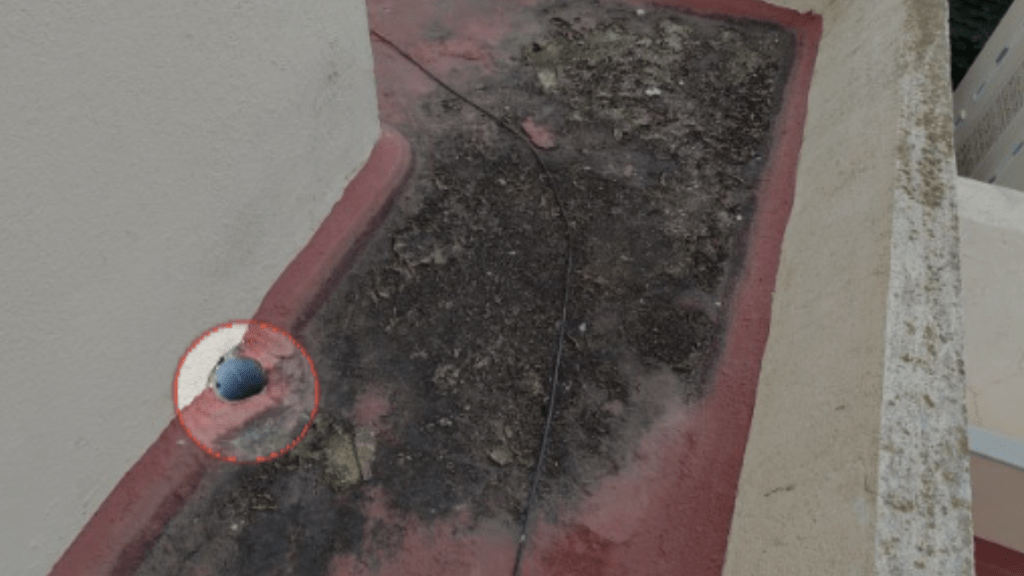
On the open terrace, improper drainage was found to be causing stagnation of water. Standing water on a rooftop is not a minor inconvenience. It adds structural load, accelerates surface deterioration, seeps into the roof slab over time, and creates the dampness conditions that eventually appear as stains and leaks on the ceilings of the floors below. Terrace waterproofing and drainage are among the most expensive remediation jobs in a residential building once the problem takes hold.
Driveway — Connected UPVC Pipe to GI Pipeline
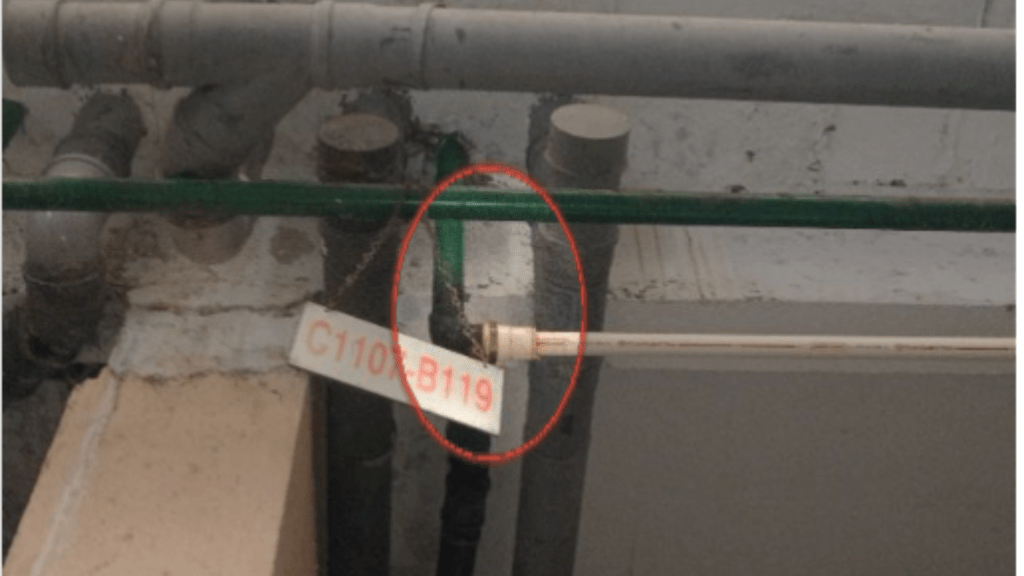
In the basement driveway, UPVC pipes were found connected directly to GI (Galvanised Iron) pipelines, with the pipelines routed through the ceiling. The recommendation is unambiguous — avoid mixing UPVC and GI together and change the entire pipeline to UPVC.
UPVC and GI are fundamentally different materials with different thermal expansion rates, different corrosion behaviour, and different jointing methods. Where they meet, the joint is a chronic weak point — prone to leakage, accelerated corrosion at the interface, and eventual failure. When this is found routed through a ceiling where future access will be limited, long-term maintenance becomes significantly more difficult and expensive.
PHE Shaft — Inspection Clean Out Caps Cannot Be Opened and Inspected

In a PHE shaft on a residential floor, the inspection clean-out caps were found to be completely inoperable — they could not be opened. These access points exist for one reason: to allow maintenance teams to inspect and clear the drainage system without dismantling the pipework. An inoperable clean-out makes that entire section of drainage effectively unserviceable. Every future blockage in that shaft becomes an access problem rather than a routine maintenance call.
Landscape — Soil Settlement Observed in Rain Water Harvesting Pit
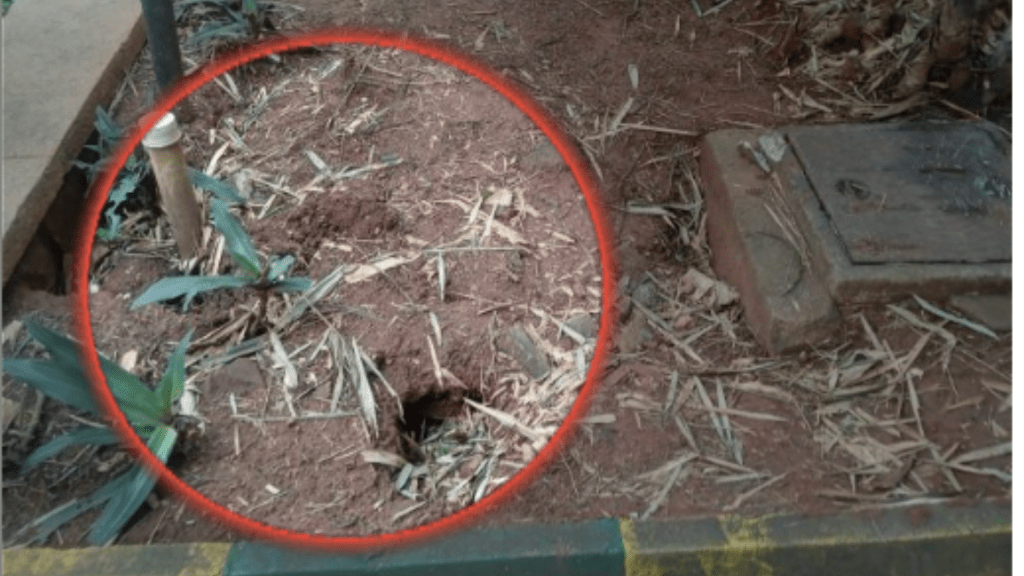
In the external landscape, soil settlement was observed in the rainwater harvesting pit. Rainwater harvesting systems are not just infrastructure — in residential complexes they are a statutory requirement and contribute directly to groundwater recharge and the building’s long-term water sustainability. Soil settlement in the pit compromises capacity, disrupts the infiltration process, and can cause the pit structure to collapse or become entirely ineffective. This needs to be restored before the system can be considered functional at handover.
What All of This Tells Us
These findings span every zone of a building — basement car parking, driveway, residential PHE shafts, open terrace, and the external landscape. They include a live safety hazard, active leaks, stagnating water, incompatible pipeline materials,, inaccessible maintenance points, and compromised rainwater infrastructure.
These are classic plumbing defects in apartments. Every single one of them can be silently inherited by an RWA without question if no independent inspection takes place before handover.
Why a Formal Audit Changes Everything
A formal audit is the only reliable way to surface plumbing defects in apartments before the RWA signs the handover. Under RERA, builders carry legal responsibility for construction quality for five years after handover. But that obligation only has teeth when deficiencies are formally documented before possession is signed.
Once an RWA accepts handover without an audit, the burden of proving a defect was pre-existing falls entirely on the residents. With a formal audit engaged with Nemmadi every snag has a photograph a timestamp, and location (car parking, driveway), presented to the RWA management.
The difference between finding a plumbing downpipe discharging over electrical cables before handover, versus discovering it after a short circuit, is the difference between a builder’s repair and a resident’s crisis.
Conclusion
From a drain pipe discharging over electrical cables to soil settlement in the rainwater harvesting pit, plumbing defects in apartments represent exactly what happens when construction quality is not independently verified before handover. From mixed pipeline materials to stagnating rooftop water — none of these problems announce themselves.
All of them require a skilled engineer, systematic access, and a structured audit process to surface. And all of these can be found before handover — giving the RWA the evidence and the leverage to demand rectification while the builder is still fully responsible.
Plumbing defects in apartment complex do not wait. The longer they go undocumented, the harder they are to fix — and the more the cost shifts from the builder to your residents.
Frequently Asked Questions (FAQs)
Q1: What are the most common plumbing defects in new apartments? A: The most common plumbing defects in new apartments include active leakages from rainwater pipelines, rusted pipe support clamps with no anti-corrosion treatment, mixed UPVC and GI pipelines, missing or inoperable inspection clean-out caps, improper drainage causing water stagnation on terraces, and plumbing downpipes discharging over electrical cables. These defects are rarely visible during a standard builder walkthrough and require a trained inspector to identify.
Q2: Why do plumbing defects in new apartments go unnoticed before handover? A: Plumbing systems in large apartment complexes run through shafts, basements, terraces, and landscape areas that are not part of a standard builder walkthrough. Without a systematic zone-by-zone inspection using a structured checklist, defects like rusted clamps inside PHE shafts, blocked landscape drains, or leaking rainwater pipelines in basement driveways remain hidden until residents move in and the cost of repair shifts entirely to the RWA.
Q3: What is a plumbing audit in an RWA HOTO inspection? A: A plumbing audit in an RWA HOTO inspection is a systematic check of all common-area plumbing systems — including water supply pipelines, drainage networks, PHE shafts, rainwater pipelines, terrace drainage, and external landscape plumbing. Every deficiency is photographed, recorded with a quality check number, timestamped, and classified by priority. After the builder rectifies the defects, a de-snagging visit confirms each item has been properly resolved before handover is accepted.
Q4: Can an RWA claim rectification from the builder after handover? A: Under RERA, builders are liable for construction defects for five years after handover. However, this liability is only enforceable when defects are formally documented before or at the time of handover. Once an RWA signs the handover without an independent audit, proving that a defect was pre-existing becomes significantly harder. A formal audit report with timestamped photographs and quality check records is the strongest evidence an RWA can hold against a builder.
Q5: What happens if plumbing defects in a new apartment are not fixed before handover? A: If plumbing defects in a new apartment complex are not identified and documented before handover, the RWA inherits them without any formal record. The builder has no obligation to fix defects that were never raised. Repairs then fall on the RWA — funded through maintenance collections from residents. In large complexes, unaddressed plumbing defects such as chronic basement leakages, failed rainwater harvesting pits, or corroded pipe supports can cost tens of lakhs to remediate post-handover.