
The December 13, 2025, meeting between Deputy Chief Minister D.K. Shivakumar and the Bangalore Apartments’ Federation (BAF) addressed the Karnataka Apartment (Ownership and Management) Bill, 2025—a long-awaited overhaul of the 53-year-old KAOA 1972. Important clarification: The organization present was BAF, not “GBA”—Greater Bengaluru Authority (GBA) is a separate government governance body for city administration. The bill remains in draft stage, with significant gaps affecting villas, plotted developments, and the conversion framework for existing associations.
📑 THE KARNATAKA APARTMENT (OWNERSHIP AND MANAGEMENT) BILL, 2025 – PURPOSE OF THE BILL
The December 13 meeting and Times of India coverage
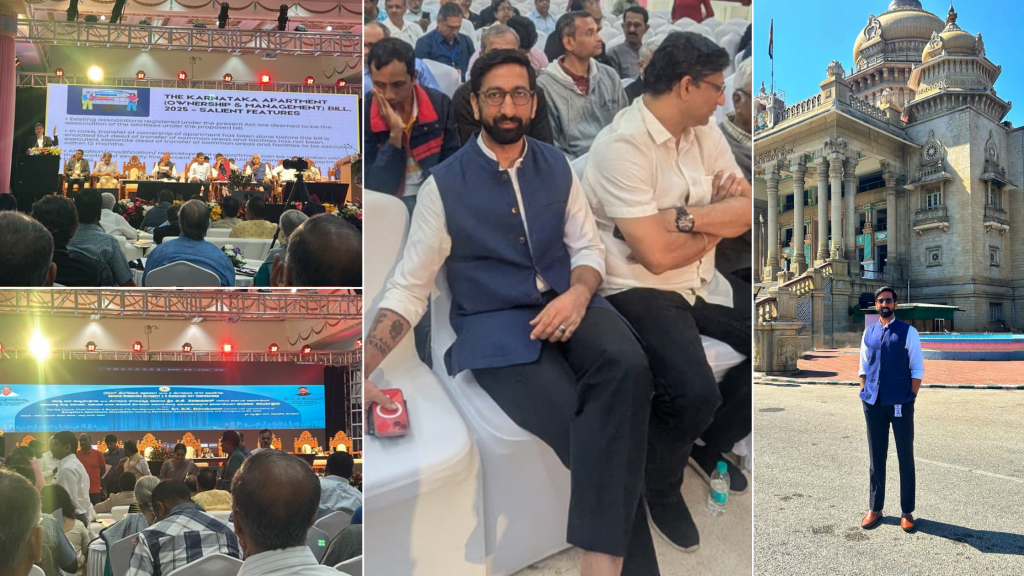
The specific Times of India Sunday edition article matching the description provided could not be located in public archives. However, the meeting is confirmed to have occurred on Saturday, December 13, 2025, at the Banquet Hall, Vidhana Soudha, Bengaluru, chaired by Deputy CM D.K. Shivakumar (also Bengaluru Development Minister).
Key attendees confirmed in news coverage:
- Satish Mallya — BAF President
- K. Arun Kumar — BAF General Secretary
- Kiran Hebbar — BAF Treasurer (whose letter about apartment voters’ electoral influence was addressed by Shivakumar during the meeting)
D.K. Shivakumar made several notable statements: “19% of Bengaluru residents are apartment dwellers. No government has tried to change the Apartment Bill since it was introduced in 1972.” He emphasized, “This government belongs to you, not to me. That is why we are taking your suggestions before finalising the law.” Attendees were given 10 days to email suggestions to gbasuggestion@gmail.com to help finalize the Karnataka Apartment Bill 2025 before the winter assembly session concludes.
Coverage appeared in Deccan Herald, News First Prime, TheBengaluruLive, and The Federal on December 13-14, 2025. The specific ToI Sunday edition may be in print-only format or behind a paywall.
BAF leadership with verified LinkedIn profiles
BAF (Bangalore Apartments’ Federation) represents 1,400+ apartment and villa RWAs comprising 3.5 lakh households (~15 lakh residents). It was registered in 2014 under Registration No. SOR/GNR/02/2014-15.
| Name | Designation | LinkedIn Profile |
| Satish Mallya | BAF President | linkedin.com/in/satish-mallya-1814502a5 |
| K. Arun Kumar | BAF General Secretary | Not verified (multiple profiles exist) |
| Kiran Hebbar | BAF Treasurer | linkedin.com/in/kiran-hebbar |
| Hemant Pai | GC Member, Legal Lead | linkedin.com/in/hemantpai |
BAF Cluster Presidents (regional heads structure):
- Avinash — President, Bangalore South Cluster
- Vishwa Venkata Reddy — Cluster Leader, Varthur & Munekollala Area
- RM Raman — President, Electronic City Cluster
- Pradeep — CV Raman Nagar Cluster Representative
Most cluster heads do not have public LinkedIn profiles clearly indicating their BAF roles. The BAF organization LinkedIn page is at linkedin.com/company/bangalore-apartments-federation-baf.
Villas and gated villa communities face coverage gaps
Finding: Villas are likely NOT covered under the KAO&M Bill 2025.
The bill’s definitions follow the Odisha Apartment Act 2023 model, where “apartment” means a part of a “building containing two or more apartments.” Since standalone villas (even in gated communities) are individual structures on individual plots—not apartments within a multi-unit building—they fall outside this definition.
Critical gaps for villa owners:
- No mandatory association formation mechanism
- No competent authority designated for villa community disputes
- Common area governance (roads, clubhouse, security) is not covered
- Villa RWAs may need to register under Karnataka Societies Registration Act, 1960, which Karnataka High Court has ruled “cannot carry out maintenance activity” legally
BAF represents “more than 1,400 apartment and villa Resident Welfare Associations,” yet the current framework appears exclusively apartment-focused. Villa gated communities will likely need separate legislation or amendments.
Plotted developments remain outside the legal framework
Finding: Plotted development layouts are NOT covered.
The Odisha Act 2023 critique (which served as Karnataka’s model) explicitly noted: “This limitation has caused many stakeholders to worry that other group housing projects, lands, or plotted schemes developed and sold by builders may go unaddressed under this Act.”
Key exclusions under the Karnataka Apartment Bill 2025 for plotted developments:
- The act applies only to “apartments or buildings converted into apartments.”
- RERA covers “allottees” of plots, apartments, or buildings, but apartment ownership acts only cover apartments in buildings
- Layout associations (governing common roads, parks, drainage) cannot register under this framework
- “Common areas” definitions contemplate shared building infrastructure, not shared layout infrastructure
Plotted development owners will likely default to the Karnataka Societies Registration Act, 1960, which presents legal challenges for maintenance enforcement.
The Grade B/Group B officer competent authority question
Finding: Specific designation awaits State Government notification after bill passage.
The current KAOA 1972 designates the Registrar of Co-operative Societies as competent authority. The Karnataka Apartment Bill 2025 is expected to follow the Odisha Act 2023 model:
| Authority | Expected Rank | Responsibilities |
| Competent Authority | Deputy Collector (Group B) | Register associations, scrutinize declarations, approve bye-laws, resolve disputes, ensure compliance |
| Appellate Authority | Collector (Group A) | Hear appeals against Competent Authority orders |
Powers expected (from Odisha model Section 23):
- Register association of allottees and bye-laws
- Scrutinize and maintain a register of declarations
- Powers of a civil court (summoning witnesses, production of documents)
- Issue directions, pass orders, and inspect apartments
- Ensure compliance by promoters and associations
The officer will likely be from the Revenue or Urban Development department. In Bengaluru specifically, the Greater Bengaluru Authority (GBA) under the Greater Bengaluru Governance Act, 2024 may play a coordination role, though the specific officer designation will only be confirmed via State Government notification post-enactment.
Converting existing associations requires 6-month transition
Finding: Existing associations will be “deemed valid” but must comply within 6 months.
Based on the Odisha Act 2023 model (Section 15(1) Proviso), the transition framework:
What happens automatically:
“Any association of apartment owners… registered under the previous law or under the Societies Registration Act, 1860 or any other law… shall be deemed to be the association of allottees for all intent and purposes of this Act.”
Mandatory compliance within 6 months:
- Bring bye-laws in consonance with prescribed model bye-laws
- Register with the new Competent Authority
- Submit required documentation
For different existing registration types:
- Under KAOA 1972: Continue as valid; update bye-laws; register with new authority
- Under Karnataka Cooperative Societies Act: Continue as valid legal entities; align by-laws
- Under Karnataka Societies Registration Act, 1960: Problematic—Karnataka High Court has ruled these “cannot carry out maintenance activity”; will need re-registration under an appropriate framework
Requirements for new projects post-enactment:
- Promoters must submit a declaration within 30 days of Occupancy Certificate
- Execute deed of transfer within 3 months of OC
- Form an association when 50% of apartments OR 7 allottees (whichever is lower) are booked
Twelve additional gaps demanding attention
Beyond the four specific questions, research identified critical unaddressed areas:
Property type exclusions:
- Mixed-use developments: Karnataka High Court judgments confirm these cannot form associations under KAOA; no framework provided
- Commercial complexes: Residential focus excludes commercial buildings entirely
- Co-living/serviced apartments: Emerging housing models not addressed
- Senior living communities: Specialized governance needs ignored
Enforcement and dispute resolution gaps:
- No penalty amounts specified for different violations (Maharashtra Act provides specific figures)
- No resolution timelines: Unlike RERA’s specified timeframes, the apartment bill appears silent
- Jurisdiction confusion: Division between new appellate authority, K-RERA, Consumer Courts, and Civil Courts unclear
Financial and operational gaps:
- Sinking fund percentage not specified (Maharashtra requires 0.25% of construction cost annually)
- Audit standards undefined: No frequency, qualified auditor requirements, or non-compliance penalties
- Insurance obligations post-handover: K-RERA ruled builders must insure common areas even after handover, but bill provisions unclear
- No structural audit requirements: Unlike Maharashtra (mandatory for buildings over 30 years)
Developer-association transition:
- No standardized handover checklist is mandated by law
- Phased development handover: No framework for projects where some towers are complete and others incomplete
- Defect liability period: RERA provides 5 years, but bill’s provisions on continued builder responsibility are unclear
Other critical omissions:
- Parking regulations: Open parking areas excluded from common area definition; no EV charging provisions
- Environmental compliance: STP maintenance standards, rainwater harvesting requirements, and e-waste management absent
- Staff employment: No provisions for security staff norms, labour law compliance, PF/ESI requirements
- Digital compliance: No technical standards for documentation, timeline for digitization, or e-governance portal requirements
Conclusion: Significant reform with notable blind spots
The Karnataka Apartment Bill 2025 represents the first major overhaul of apartment governance legislation in 53 years, introducing competent authorities, mandatory associations, and structured dispute resolution. However, villas, plotted developments, and mixed-use properties remain in legal limbo, affecting millions of Karnataka homeowners. The conversion timeline of 6 months appears aggressive for associations currently registered under problematic frameworks. Most critically, the full bill text has not been publicly released, limiting stakeholders ability to provide comprehensive feedback before the winter assembly session concludes on December 19, 2025.
For Nemmadi’s PropTech services, the transition period will create substantial demand for RWA compliance audits, bye-law restructuring, and handover documentation—particularly given the complexity surrounding existing associations and the tight 6-month compliance window.