
Buying a home in India – whether it’s your first apartment, an upgrade to a second home, or a luxury property – is one of the biggest investments you’ll ever make. Yet many homebuyers focus only on the price of a home inspection and overlook the value it delivers. This guide is a persuasive deep-dive into why a quality home inspection is worth every rupee, even if it costs slightly more. We’ll address common questions and objections like “Why should I pay you 20% more than your competitor?” and “Why do I need a home inspection at all?”, and compare our services with our competitors to show how our thorough approach provides superior value. By the end, you’ll see how investing in a top-notch inspection can save you lakhs in repairs, countless hours of hassle, and give you peace of mind – all backed by technical rigor, case studies, and evidence.
Why a Home Inspection Is Essential (Even for New Homes)
It’s a common misconception that brand-new homes or homes from reputed builders don’t need inspecting. The reality: virtually every property has defects, and new constructions often hide issues due to rushed schedules or overlooked snags. In fact, a recent survey found 65% of new homeowners encountered at least one major defect within the first year of purchase. These defects range from minor cosmetic flaws to serious problems like water leakage, structural cracks, or unsafe wiring. If not identified and fixed in time, such issues can escalate into major damage, compromising safety and costing a fortune to repair.
A professional home inspection acts as a comprehensive quality audit of your property. Trained engineers examine all critical aspects – civil workmanship, plumbing lines, electrical systems, dampness, structural elements (workmanship quality), and more – to uncover problems that are not apparent to an untrained eye. Even if your builder has an internal quality check, an independent inspection is an unbiased second layer of defense. Think of it as a health check-up for your dream home: it diagnoses any “illnesses” so they can be cured early. By carrying out a thorough inspection, “all the repairs can be identified,” helping prevent future major problems. In other words, a home inspection now is an investment to avoid surprises later.
Importantly, Indian homebuyers are protected by law when defects are found. Under the Real Estate Regulatory Authority (RERA) Act (Clause 14(3)), builders are obligated to rectify any construction defects reported by the homeowner within 30 days, at no cost to the buyer. This defect liability spans 5 years from possession for structural and workmanship issues. That means if our inspection report finds plumbing leaks, electrical faults, or structural cracks, you can officially ask the builder to fix them before you take possession or during the warranty period – and they must comply. Most reputable builders do address issues when presented with a professional report; the RERA law “empowers home buyers to forward the defects to the builders and get them rectified”. We often see builders promptly fix 100+ snags after our inspection, delivering a defect-free home to you. The key is catching those issues early, which is exactly what a quality inspection ensures.
Key Benefits of a Thorough Home Inspection
A detailed home inspection pays for itself many times over. Here are the major benefits you gain by prioritizing quality over cost:
- Save Lakhs in Future Repairs: The most tangible benefit is money saved. Any defect found during inspection will be fixed by the builder at their expense, not yours. This can amount to huge savings. For example, one inspection in Bangalore uncovered structural cracks that could have led to a ₹3,00,000 repair job – a cost entirely avoided by catching it early. In another case, a hidden dampness problem would have forced a ₹2 lakh renovation had it gone undetected. These real examples show how spending a bit more on a high-quality inspection can potentially save you lakhs of rupees by eliminating future out-of-pocket repair costs. Even internationally, studies show home inspections save buyers an average of $14,000 (≈₹11.5 lakhs) in purchase and repair costs
[themortgagereports.com]. In short, the return on investment is enormous – the inspection fee is a fraction of what you’d pay to fix unchecked issues later. - No Move-In Nightmares or Disruptions: A thorough inspection ensures your new home is truly move-in ready. Without it, you might move in happily only to face nightmares within weeks: water seeping through walls during the monsoon, electrical trips due to faulty wiring, or bathroom leaks staining your ceiling. Fixing these after move-in is disruptive – you’d have to deal with workers coming in, drilling or repainting, and living amidst repairs. By contrast, if these issues are found beforehand, the builder can address them before you shift your furniture and family in. You get to avoid the hassle of post-possession repairs entirely. Imagine the relief of unpacking in a home where you won’t be startled by leaks or power failures in the first rainy season because all such issues were already caught and fixed. A quality inspection spares you the stress and inconvenience, allowing you to enjoy your new home from day one without any “surprise” repair work.
- Time Savings and Convenience: Time is precious, and a good inspection saves you plenty. First, it saves you time by consolidating all defect discovery into one session – our experts might find in 4 hours what would take you months of living in the house to notice. Second, getting issues fixed pre-handover is typically faster. Builders usually resolve snag lists within a few weeks before final possession rather than you spending countless weekends later coordinating with plumbers, electricians, and contractors for each problem. There’s also the advantage of not having to chase the builder repeatedly after you’ve moved in – which can be a slow process once they’ve moved on to other projects. In essence, an inspection now is a proactive strike that saves you the time and energy of reactive fixes later. It also means you can plan your move with confidence, without worrying about delaying it for repairs or taking time off work to supervise fixes.
- Assurance of Quality and Safety: For many buyers – especially high-net-worth individuals investing crores in a property – peace of mind and quality assurance are paramount. A technical inspection provides exactly that. It verifies that you are getting the quality that was promised by the builder, and that all installations are safe and up to standards. We check that electrical systems are safe (no loose connections, proper earthing, correct MCB ratings), plumbing is sound (no leakages, adequate water pressure, proper drainage flow), and structural elements are secure. We use tools like laser levels and measuring tapes to ensure walls and rooms are of the correct dimensions and plumb (vertical alignment), and thermal cameras to detect hidden water seepage or damp spots behind walls and tiles. Every door, window, outlet, and faucet is tested. This level of detailed, technical scrutiny guarantees you won’t face safety hazards like electrical shocks or weakened structures. It’s especially critical if you’re a second-time buyer upgrading to a bigger home – you want to ensure this new home is flawless, unlike any issues you may have experienced in your previous one. For luxury homebuyers (HNIs), an inspection ensures that even in a high-end property (where stakes are high), the workmanship meets the premium standard you expect. Simply put, a comprehensive inspection is how you protect the quality of your investment and ensure your family’s safety.
- Documentation and Leverage: Finally, the inspection report itself is a valuable document. Ours is a systematic, evidence-backed report detailing each defect with descriptions and photographs. This gives you leverage in getting things fixed – you have a formal record of issues to hand over to the builder’s team. Builders appreciate specifics; for instance, instead of vaguely saying “there’s a leak somewhere”, you will provide a report showing “seepage detected in the northwest corner of the master bedroom wall – likely from a window frame gap” with a photo. This makes it easier for them to pinpoint and rectify the issue. A well-documented report also serves as a checklist during your final walkthrough with the builder, ensuring nothing is missed. In cases of any dispute, such a report is proof of issues found, and the fact you notified them (important if escalation to RERA is ever needed). Essentially, you’re equipping yourself with technical evidence, which makes builders far more responsive to addressing the defects. Many of our clients have told us that once they showed our detailed report, the builder’s site engineers fixed almost everything on the list without argument, because the evidence was clear and the fixes were necessary for handover.
With these benefits in mind, it’s clear that skipping or skimping on a home inspection can be a costly mistake. As one industry article aptly put it, unexpected repair issues later are among the biggest regrets of homebuyers – and an inspection is the best way to avoid that fate. In the next sections, we will address specific concerns you might have and show how our service, while 20% more expensive than some competitors, gives you far greater value in return.
Addressing Common Objections and Concerns
Buying a home can make anyone budget-conscious and skeptical – which is why questions and objections about home inspections are natural. Let’s tackle the most common ones head-on, with honest and evidence-backed answers:
Objection: “Why should I pay you 20% more than your competitor?”
It’s true that our inspection service is priced ~20% higher than some competitors. The key question to ask is what you get for that difference. We firmly believe (and our clients will attest) that a more thorough, high-quality inspection pays for itself many times over – and a cheaper, cursory inspection can cost you more in the long run if it misses issues. Here’s why our slightly premium pricing delivers superior value:
- Depth Over Quantity: Some competitors advertise sheer numbers – for example, A competitor claims to cover “400+ checkpoints” in an inspection. While we also cover hundreds of items, we focus not on just ticking boxes but on deep analysis of each critical area. Our inspectors spend the extra time diagnosing the root cause of issues, not just note the symptom. For instance, if we find a crack in a wall, we don’t just mark it as a defect; we investigate further – is it superficial plaster shrinkage or does it indicate a deeper structural issue? – and document the cause and remedy. This depth may mean our inspections take a bit longer or involve more expertise, but it ensures no serious issue is glossed over. In contrast, a hurried inspection that tries to cover a checklist cheaply might miss subtle yet important problems (like slight floor slope, early signs of seepage, or an underrated circuit breaker). Paying 20% more ensures you get an inspection that is unhurried, meticulous, and insightful. As one client told us, “I’d rather pay a bit more for someone who finds everything than save a little and have a half-baked inspection that overlooks a ₹5 lakh problem.”
- Highly Qualified Inspectors: We have built a team of experienced professionals – not just civil engineers, but specialists in plumbing, electrical, and structural domains. Our inspection team for a typical flat often includes two experts working in tandem: say, one focusing on civil/structural aspects and another on MEP (Mechanical, Electrical, Plumbing). All our inspectors are rigorously trained, and many have 2-5+ years of field experience in construction quality. This multi-disciplinary expertise costs more to deploy, but it means a keener eye on every detail. By comparison, a lower-priced competitor might send a single inspector to cover everything in one short visit. Even if that person is competent, no single generalist can match the collective insight of specialized experts. Our slightly higher fee enables us to put the best minds on the job, giving you a far superior assessment of your home’s condition. We stand by our findings, because they’ve been double-checked – in fact, every report is peer-reviewed by a senior engineer before we deliver it, as an extra layer of quality control (a practice we believe is unique to us).
- Advanced Tools and Technology (Included as Standard): We invest in state-of-the-art inspection tools and include their use in every inspection by default. For example, we use thermal imaging cameras on all inspections to scan for hidden water leaks and dampness inside walls/floors – a technique that can reveal moisture issues invisible to the naked eye. We use laser distance meters to verify room dimensions. We carry circuit testers to check every plug point’s wiring and grounding. Even if it’s a small 2BHK, our team comes equipped with this gear. Many competitors either do not use such equipment or offer it only in higher packages. Our competitor, for instance, has a separate “Dampness Inspection” service with thermal scanning – implying that their basic home inspection might not comprehensively include thermal scans. In contrast, we treat moisture detection as a core part of our standard inspection, at no extra charge. By paying a bit more to us, you are effectively getting all these technical checks included (which you’d otherwise pay extra for). Our philosophy is that an inspection should be technically rigorous every time – not an upsell. So the 20% higher fee directly translates to more comprehensive testing and diagnostics on your property. This ensures higher chances of catching tricky issues (like a slow plumbing leak inside a wall or an overloaded electrical circuit) that cheaper inspections could miss.
- Holistic Coverage (No Hidden Exclusions): Our inspection covers everything from the floor to the finishing. To list a few, we inspect: civil works (walls, floors, dado, doors/windows alignment and gaps), plumbing (every faucet, drain, flush, geyser point, water pressure, leakage), electrical (switches, outlets, DB/fuse box, earthing, appliance points), paint and finishes, carpentry (doors, frames, cabinetry if provided), tile quality and grouting, structural elements (workmanship quality) in accessible areas (columns/beams in parking or inside flat if visible), and even measure the carpet area of your flat to ensure you got what was promised. We also verify the brand and model of fittings (sanitaryware, electrical fixtures) against what was advertised. In short, it’s an end-to-end inspection. Some low-cost competitors might skip certain “time-consuming” checks to cut costs – e.g., not checking every electrical point or not climbing on the roof/loft, or they might not measure the apartment size independently. We do it all. We encourage you to compare line-by-line what’s covered; you’ll find that our scope is equal or greater. When you pay that extra 20%, you ensure that no aspect of your home is left uninspected. It’s a comprehensive package, so you won’t need to hire separate services (like a separate area measurement or a separate leak detection test) – saving you money in aggregate.
- Post-Inspection Support and Follow-Up: Our commitment doesn’t end with handing you the report. We go the extra mile to make sure you reap the benefits of the inspection. For 60 days after the inspection, you can call us for any questions – free of charge. If the builder’s team is unsure about something in the report, we are happy to clarify the issue. Moreover, once the builder claims to have fixed all issues, we offer a re-inspection visit to verify the fixes (this is included in our package). This second visit checks that all previously noted defects have been properly resolved, or if any new issues cropped up during repairs. All of these after-service benefits are possible because of our pricing factors in the resources for follow-up. So your 20% extra spend ensures you’re not left hanging after the report – we are with you until your home is truly defect-free. This continuity can be the difference between knowing about a problem and actually getting it resolved fully.
When you add up these factors – deeper inspection, expert team, advanced tools, all-inclusive scope, and post-inspection support – the difference in value becomes clear. Our slightly higher fee is what allows us to deliver an inspection that is far more exhaustive and reliable. It’s like the difference between a basic check-up and a full diagnostic health exam; the latter costs a bit more but can potentially save your life. Similarly, our inspection can save your home (and wallet) from serious troubles down the road. Many customers who initially asked this question (“why pay more?”) later told us that the issues we found and got fixed would have cost them 5-10 times our fee in repairs, not to mention headaches. In summary, you pay 20% more to potentially save 200% or more in future costs and to secure 100% peace of mind.
Objection: “Why should I believe you?”
It’s wise to be skeptical and demand credibility from anyone inspecting your future home. Here’s why you can trust us and our service:
- Proven Track Record: We have inspected hundreds of homes across multiple cities with an excellent success rate of issues resolved. Our portfolio includes everything from 1BHK starter homes to large villas and high-rise luxury apartments. In every case, we’ve provided clients with factual, actionable findings that stood the test of scrutiny by builders and even other experts. For instance, in a recent project in Hyderabad, our report identified a major seepage in a top-floor apartment that even the builder’s project team had missed. The client was initially unsure, but we used moisture readings and photographs to demonstrate the issue. The builder acknowledged it and carried out a full terrace water-proofing redo, saving the client from future ceiling leaks. We could cite dozens of such instances. The point is: our work speaks for itself. Many of our new customers come through referrals from satisfied clients. We’re happy to connect you with a past client similar to your case (first-time buyer, upgraders, etc.) if you’d like to hear their experience directly.
- Credentials and Expertise: Our company is one of the pioneers in the Indian home inspection industry. We adhere to Indian Standards for quality – our processes align with norms from bodies and standards published by the National Building Code and the Bureau of Indian StandardsI, no adaptation to Indian building practices is required. We have also developed in-house protocols that we continuously refine. – similarly, we consult structural engineers and industry veterans to keep our inspection checklist and methods top-notch.) When we say something in our report, it’s backed by engineering principles and factual measurements. Also, we have no conflict of interest – we are an independent third party. We are not affiliated with any builder, broker, or maintenance company, and our only allegiance is to you, the homebuyer. This independence is crucial in earning your trust: our only job is to find the truth about your property’s condition.
- Transparency and Evidence in Reporting: We believe in complete transparency. During and after the inspection, we explain our findings to you with evidence. If we mention a defect, you will see a photo of it in the report, often annotated or alongside tool readings. For example, if we report “Hollow sounding tiles in living room,” we will have an accompanying image reference where we tapped and showed the hollow sound area. If we say “voltage drop in an outlet,” we’ll include the multimeter reading. This evidence-backed approach means you don’t have to take our word for it – you can see the issues yourself. Our sample reports are available for you to review before hiring us, and we encourage questions. Being technically oriented, you might appreciate that we also include reference to building code or standards where applicable (e.g., if a staircase railing is lower than the safe height as per National Building Code, we’ll note that standard). All of this is to assure you that our findings are not opinions but facts. And if by chance we inspect and find almost nothing wrong (which is rare but has happened for a couple of extremely well-built flats), we will report exactly that – we don’t “invent” problems to justify our fee. In one case, a customer of a high-end builder was surprised that the home had only minor touch-ups needed; we delivered a 25-page report (shorter than the usual 100 pages) because that’s all there was. We are honest in our work – if your home is truly top-notch, we’ll happily tell you so.
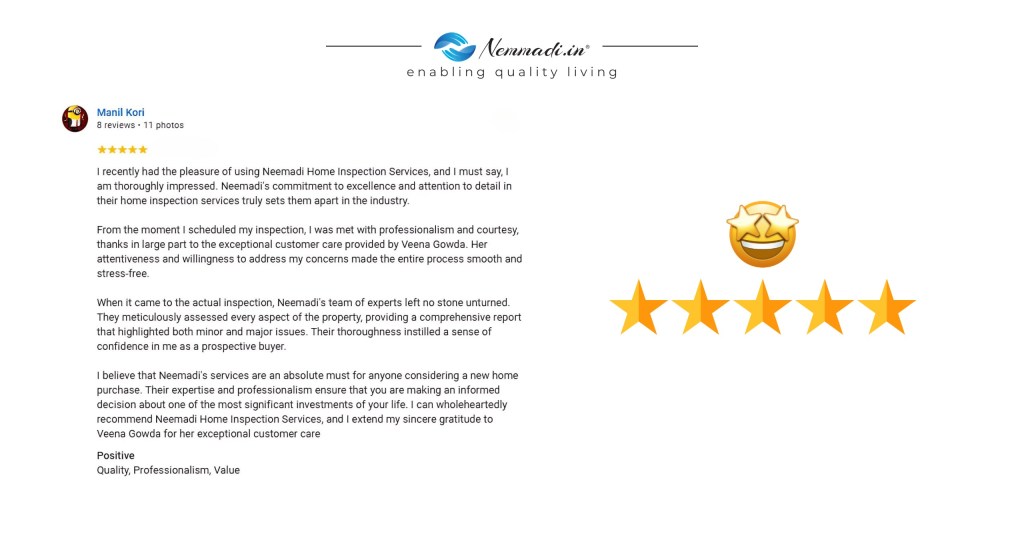
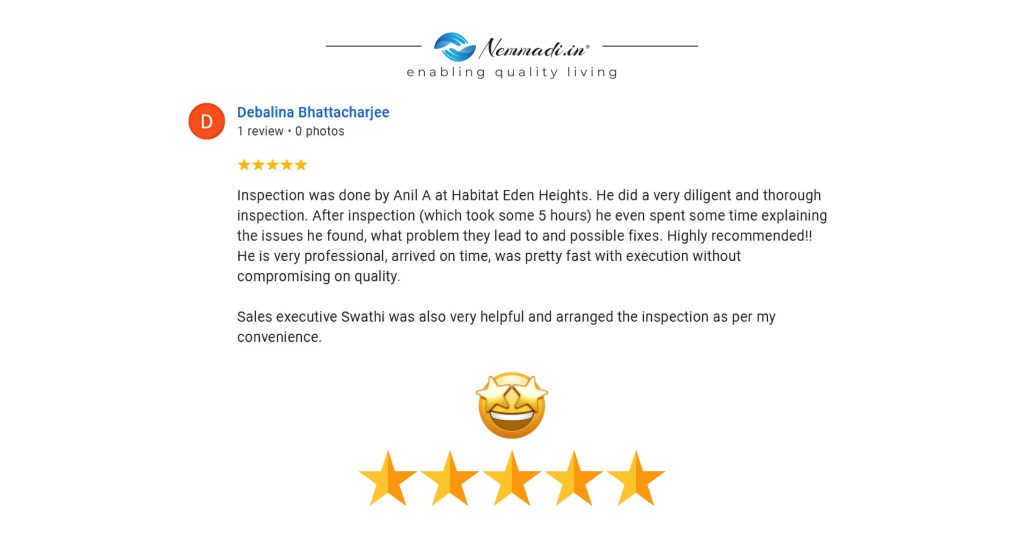
- Client Testimonials and Case Studies: “Trust, but verify,” as the saying goes. We invite you to see feedback from our clients as a verification of our credibility. Here are a few excerpts from recent customers:
- .

- .
- Guarantee and Ethics: We stand by our service. If you were to be unsatisfied or if you felt we missed a major issue that we reasonably should have caught, we have a satisfaction guarantee – we either re-inspect or refund, no arguments. Thankfully, we’ve never had to issue a refund due to oversight, but the guarantee is there to show our confidence and integrity. We also carry professional indemnity insurance for our services, which means in the unlikely event of a gross miss on our part causing you loss, you have recourse. Our goal is to never put a customer in that position. Everything we do is geared towards thoroughness and accuracy, so you can believe in our findings with confidence.

In summary, you have every reason to trust us: extensive experience, transparent reporting, and a track record of happy customers. We encourage due diligence – compare our sample report with others, ask us technical questions, and you’ll see that we talk straight and deliver on promises.
Objection: “Why do I need a home inspection at all?”
You might wonder if a home inspection is really necessary, especially if the property is new or if the builder is reputed. Consider this: a home is a complex product with thousands of components (bricks, pipes, wires, fixtures) assembled by human hands. Even top builders can have slip-ups – perhaps a subcontractor used a wrong sealant, or a laborer didn’t fix a window frame tightly, or a batch of electrical switches was faulty. These things happen routinely, and often the standard internal checks don’t catch everything. According to an industry report, “even newly constructed homes exhibit signs of poor workmanship” and defects that need fixing. Without an independent inspection, you won’t discover many of these until later when they become obvious (for example, cracks appearing or a leak seeping through paint).
A home inspection is your quality assurance and risk management step. For first-time buyers, especially, it’s a critical safety net – you don’t have prior experience to know what can go wrong, so our inspection is an educational eye-opener about your home’s true condition. It answers questions like: Is the plumbing done right? Are there any concealed leaks? Is the roof waterproofed? Are the walls straight and properly cured? Does every outlet and appliance work safely? Most buyers are not equipped to evaluate these thoroughly on their own. Our inspection ensures “the house is in a good enough condition to move-in”, and all major/minor flaws are identified. This knowledge lets you move in with confidence or get the builder to set things right first.
Skipping the inspection is a bit like buying a car without a test drive or assuming a new car has no defects because it’s new – whereas in reality you’d at least check it. Given the scale of investment in a home and the potential cost of hidden defects, an inspection is a very small upfront step that can prevent huge future regrets. In fact, one analysis showed 86% of homebuyers’ inspections find some issue – so the odds are there will be something to fix. If by chance your home is the exception (pristine quality), then an inspection gives you that peace of mind confirmation in writing. If not, you’ll be thankful you did it.
Some might say, “my builder gives a 1-year warranty, so I’ll just move in and they’ll fix issues within a year.” Yes, they might fix some, but consider a few points: First, many issues cause inconvenience or damage when they manifest (a plumbing leak could ruin furniture or cause mold before you realise it, an electrical fault could fry an appliance or be a fire hazard – you don’t want to experience the problem even if it will be fixed later). Second, after you take possession, you have less leverage – the builder’s urgency to fix things often reduces once handover is done. You may find yourself constantly following up. It’s far better to have all issues identified and ideally fixed before you and your family occupy the home. Third, certain problems, if not documented at possession, might later be claimed as “wear and tear” or improper use. A third-party inspection report at handover time creates a record that these issues were pre-existing, making it easier to claim fixes under warranty. Essentially, a home inspection is about being proactive vs. reactive. It’s an upfront assurance step that every prudent homebuyer should take – much like you wouldn’t buy a property without a title check, you shouldn’t buy one without a quality check.
Finally, for those on a tight budget, consider that the cost of an inspection is usually only 0.1% – 0.2% of the property cost . That percentage is minuscule for the protection it offers. As the old saying goes, “penny wise and pound foolish” – skimping on an inspection to save that 0.1% could expose you to defects that cost 5% or 10% of the property price to fix. Therefore, the question is not “can I afford an inspection?” – it’s “can I afford not to have one?”. We strongly believe the answer is no, especially with the high rates of defects reported by new homeowners today. Home inspection isn’t an added expense; it’s an essential part of buying a home – just as important as registration or interior planning – because it safeguards your investment and comfort.
Objection: “Will the builder actually make changes if defects are found?”
Many homebuyers worry that even if an inspection finds issues, the builder might refuse to fix them, rendering the inspection pointless. In our extensive experience, if approached correctly, builders do address the majority (if not all) of legitimate issues identified in a professional inspection report. Here’s why and how:
- Legal Obligation: As mentioned earlier, RERA law mandates builders to fix reported defects within 30 days, and they remain liable for structural/workmanship defects for 5 years
sobha.com. Builders are well aware of this. When we document an issue, we are essentially helping you exercise your legal right to have a defect rectified. Knowing that a buyer can escalate unresolved issues to the RERA authority (which can impose penalties), most builders take defect reports seriously. It’s worth noting that “the RERA Act empowers homebuyers to get defects rectified by the builder”, which has improved builder responsiveness in recent years. - Reputation and Handover Protocol: No builder wants unhappy customers or complaints tarnishing their reputation, especially in this age of social media and reviews. They also typically cannot hand over a unit to you if there are known major defects – it’s in everyone’s interest to close issues. When you present a comprehensive, well-structured report, it signals to the builder that you have done your homework. Most mid to large builders have a process to handle the “snag list” during possession; our report essentially becomes that snag list. We have seen builders large and small assign engineers and contractors to fix everything from tile re-fixing, re-painting, sealant application, electrical component replacement, to plumbing fixes once they receive the list. The more clear and itemized the report (ours usually lists each defect with location, description, and recommended fix), the easier it is for them to tick off tasks. We often hear from builders’ quality teams that they appreciate external inspections because it helps them ensure a satisfied customer – it’s like an extra QC pass for them. So yes, builders do make the changes in most cases.
- Which Issues Get Fixed: Generally, anything that affects functionality, safety, or violates promised specifications will be fixed without much debate. For example, if an electrical outlet isn’t working, or there’s a water leak, or a door is not closing properly, no builder will refuse to fix those – they are basic deliverables. Even things like uneven painting or minor cracks are usually attended to, because they want you to sign off on the handover. There might be rare instances where a builder could push back on something that they consider extremely minor or “within tolerance” – for instance, a hairline crack that’s truly superficial or a slight color variation in tile. In such cases, we help you understand if it’s worth insisting or not (some hairline plaster cracks, for example, can be cosmetic and reappear even after repair due to material properties – we’ll tell you honestly if that’s the case). However, the vast majority of issues we flag are genuine defects that any reasonable builder will address. In fact, one of our case studies involves a builder initially hesitating to change a misaligned window (a fairly big task) – but when the buyer showed them that rainwater was seeping due to the gap, they replaced the entire window frame. Builders won’t want to leave you with a water-ingress issue, for example.
- Reality Check: It’s important to set expectations: builders will fix defects, but it may take a bit of coordination and patience to get everything done. Typically, within a 2-4 week period, most if not all issues are resolved. We advise homeowners to schedule their move only after giving the builder a few weeks with the report. Nearly all our clients have handed over the report, followed up periodically, and gotten satisfactory results. In the unlikely event a builder outright refuses to fix a significant issue, you have strong recourse via RERA complaint – but honestly, among the hundreds of cases we’ve handled, that level of conflict is extremely rare. We can confidently say that a good inspection report is like a to-do list for the builder – one that they do execute. After all, they want the final payment and the handover completion as much as you want a perfect home.
To sum up, builders do make the changes when presented with clear evidence of defects. The combination of legal requirements and the desire to maintain customer satisfaction ensures that your investment in an inspection translates into real fixes, not just a paper report. In fact, many of our clients are pleasantly surprised at how much the builders accommodate – often everything on the list is done, because at the end of the day, delivering a defect-free home is also in the builder’s best interest (for reputation and to avoid later warranty claims). Remember, our goal aligns with yours and even the builder’s: to ensure you get a home that’s safe, sound, and as per promised quality.
Objection: “How are you different from your competitor ?”
there are key differences in approach, coverage, and overall value. Here’s a direct comparison highlighting how we stand out:
- 1. Inspection Thoroughness – Beyond the Checklist: Our competitor markets their service heavily on quantity, e.g. “400+ quality checkpoints” covered by their engineers. We respect that – it signals a broad coverage. However, our approach emphasises both breadth and depth. Our checklist is comparably extensive with over 1500 check points for a 2000 sft apartment (covering all major systems and minor details), but we place a strong emphasis on investigating the cause and severity of each finding, not just noting it down. Our inspectors are trained to spend extra time on-site if needed to get to the bottom of unusual observations. We intentionally limit the number of inspections per day per inspector so that each client gets maximum attention. It’s a different philosophy: we’re boutique-style thorough, whereas the competitor is more high-volume. The result is that our reports can sometimes uncover issues that a more templated approach might miss. We’ve had clients who previously used another service for a different property come to us and remark that our report was more insightful and detailed. In sum, we differentiate by leaving no stone unturned, even if it means checking 1450 points instead of 400, or spending an extra hour – we don’t watch the clock when your home’s quality is at stake.
- 2. Technical Rigor and Equipment: Both our competitor and we use modern tools and technology. They tout being “India’s most tech-enabled” with a proprietary app and high-tech equipment. We too use a robust digital system for reporting and similar tools (thermal camera, laser meter, moisture meter, etc.). Where we differ is how we integrate technology into the inspection. Our inspectors use tools as an aid to engineering judgment, not as a replacement. In contrast, our standard process includes full thermal imaging coverage of susceptible areas (bathroom walls, roof ceiling, exterior walls) as a default. We also perform what’s called Non-Destructive Testing (NDT) throughout – meaning we use devices to test without breaking anything (tapping tiles to find hollows, using infra-red for wiring hot-spots, etc.). A subtle difference: because our team includes domain specialists, we sometimes deploy specialised tools that general inspectors may not. For example, our electrical specialist carries a device to test Earth fault loop impedance and verify RCD (residual current device) trip times – very specific electrical safety tests that go deeper than a normal checklist. Our plumbing specialist might use a pressure gauge to test water pressure at different fixtures, not just turn taps on/off. These granular checks might not be part of a competitor’s standard routine. So, while on paper both services use advanced tools, we ensure those tools are employed to their fullest extent on every inspection, and we have niche instruments when needed for a thorough diagnosis. It’s the difference between using tech as a buzzword versus using tech to its maximum potential.
- 3. Inspector Qualifications and Team Composition: Our competitors pride themselves on using qualified civil engineers for inspections, and their co-founders are from Tier 1 institutions which adds to their credibility. We equally have highly qualified personnel – including civil engineers, of course, but also folks with experiential knowledge, electrical engineering, and construction management backgrounds. One difference is how we allocate our people: their model usually has one inspector per inspection, who may consult another remotely if needed. Our model often assigns two inspectors or more for larger properties or ones with known complexity, to cover more ground effectively (for a typical apartment, one inspector can handle it, but for anything 3BHK or bigger, we prefer two sets of eyes). This not only speeds up the process but ensures specialist attention (e.g., while one checks all electrical points, the other is simultaneously scanning for dampness and structural issues). We believe this yields a more comprehensive outcome. Additionally, our internal training program is very rigorous – we shadow new inspectors for their first many inspections, cross-check reports, and they only solo when consistently meeting our quality benchmarks. It’s a more personalized service versus a potentially production-line approach elsewhere.
- 4. Reporting and Detail: Both companies provide a detailed report with photos. However, clients who have seen both have noted that our reports tend to be more detailed, whereas the competitors are very point-wise and tabular. We include not just what the defect is, but often why it matters and what the suggested remedy is. We also prioritise issues by severity, marking which ones are critical (safety/structural), which are moderate, and which are cosmetic. This helps you negotiate and ensure important things are addressed first. The level of annotation in our report (circles on images, diagrams if needed to explain a point) is something we take pride in..
- 5. Comprehensive Services vs. Specialized Focus: Our Competitors offer many types of inspections (home, dampness, area, multi-stage construction, etc.) as separate services. Our focus is primarily on comprehensive home inspections for buyers (and some handover audits for RWA). By focusing on our core expertise, we ensure our service is the best it can be. We’re not trying to sell you multiple packages or add-ons; we have one Diamond-standard inspection that covers it all. If you need multi-stage inspections during construction, we do offer it on request, but our mainline service is the possession-time inspection for end consumers, where we pour all our energy. This specialisation means we’re deeply experienced in exactly the kind of inspection you as a homebuyer need right now, whereas competitors juggling many service lines might not give the same depth in each. It’s a matter of focus – and our focus is you, the homebuyer, and delivering you the most thorough inspection in the market.
In summary, while our competitors and others have brought visibility to home inspections in India (which is great for awareness), our service differentiates itself by offering greater thoroughness, more personalised expert attention, and end-to-end support, even if at a somewhat higher fee. If they are the convenient, mass-market option, we position ourselves as the premium, detail-oriented choice for those who want the very best analysis of their prospective home. We are confident that our differences translate to a better outcome for you – a home that is truly checked and perfected in every sense. And ultimately, that’s what matters: the quality of your home and your peace of mind.
What Next
Purchasing a home is a milestone – and a moment of pride and joy. A professional home inspection ensures that your joy isn’t short-lived due to avoidable problems. The arguments are clear: while cost is a factor, value is what truly matters. A cheaper inspection might save you a little now, but could cost you big later if it misses critical defects. On the other hand, a comprehensive inspection like ours, even at a ~20% higher fee, is designed to save you money, time, and stress by catching everything upfront and facilitating fixes at the builder’s cost. We’ve addressed the common objections – demonstrating that paying a bit more gets you a lot more in quality, that you can trust our expertise, that an inspection is absolutely necessary (given how common defects are, even in new homes), and that builders will indeed act on the findings (backed by legal mandates and our experience). We’ve also compared our service to our competitors and shown that despite their strong presence, our dedication to depth, personalised service, and end-to-end support offers unmatched value for money.
For Indian homebuyers – whether you’re stepping into homeownership for the first time, buying a second home with lessons learned, or investing in a high-end property – the message is the same: don’t compromise on your home inspection. It’s not just an add-on; it’s a crucial step in the homebuying process that protects your investment and your family’s comfort. By using a technical, detail-oriented inspection service, you’re effectively getting an insurance policy against construction defects – one that pays out in immediate repairs and long-term peace of mind. Remember, the cost of preventing a problem is almost always lower than the cost of fixing it later. As we’ve evidenced, a quality inspection can prevent problems that would cost lakhs to set right, not to mention the inconvenience avoided.
We hope this guide has provided clarity and confidence in the value of home inspections. The data, and comparisons are all aimed at helping you make an informed decision. Our structured approach and technical rigor resonate with homebuyers who, like you, appreciate precision and facts. We believe that once you weigh the benefits, you’ll agree that the question isn’t “Can I afford a thorough inspection?” but rather “Can I afford not to have one?”
Next Steps: If you’re convinced (and we hope you are) that a high-quality home inspection is the way to go, we invite you to reach out and schedule your inspection with us. We’ll be happy to walk you through our process in detail, share a sample report, or answer any lingering questions. Even if your possession is a few weeks away, it’s a good time to book early. Let us partner with you in this exciting journey and ensure your new home is everything you dream it to be – with no hidden surprises. After all, your home deserves nothing less than the best, and we’re here to deliver exactly that.
ready to make your dream home a safe and sound reality? Let’s get inspecting!
References (for the data and claims made above):
- New homes often have hidden defects; timely inspection prevents major damage – rprealtyplus.com.
- RERA law requires builders to fix reported defects within 30 days at no cost to the buyer sobha.com, empowering homebuyers to get issues rectified rprealtyplus.com.
- 65% of new Indian homeowners reported at least one major defect in the first year nemmadi.in – showing the prevalence of issues.
- Even a U.S. study found inspections save buyers ~$14k on average themortgagereports.com.
- Example defect costs: structural cracks could lead to ₹3 lakh in repairs if not fixed early nemmadi.in ; dampness and mold remediation can cost ₹2 lakh nemmadi.in – all avoidable with prompt inspection and builder fixes.
- PropChk’s service covers “400+ checkpoints” with qualified engineers rprealtyplus.com , but our approach delivers even deeper analysis and personalized attention (as detailed in our comparison)
By considering these facts and success stories, you can move forward with confidence that prioritizing a quality home inspection is a smart, prudent decision – one that you’ll be very happy you made in the years to come. Here’s to a future of happy, hassle-free homeownership!